#include <lowrankfunction.h>
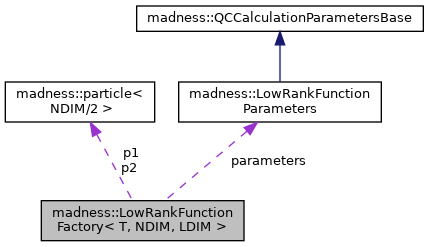
Classes | |
| struct | ProjectionState |
| struct | ThreshGuard |
| RAII guard for temporarily changing FunctionDefaults and functor thresh. More... | |
| struct | YFormationResult |
Public Member Functions | |
| LowRankFunctionFactory ()=default | |
| LowRankFunctionFactory (const LowRankFunctionFactory &other)=default | |
| LowRankFunctionFactory (const LowRankFunctionParameters param, const Molecule &molecule) | |
| LowRankFunctionFactory (const LowRankFunctionParameters param, const std::vector< Vector< double, LDIM > > origins={}) | |
| std::vector< Vector< double, LDIM > > | build_grid (double ve, long max_points=0) const |
| Build a grid around the given origins (or uniform random if no origins). | |
| std::string | diagnose_error (double error, double prev_error, long rank, double tol, double thresh, const Tensor< T > &ovlp_h) const |
| std::vector< Function< T, LDIM > > | form_Y (const LRFunctorBase< T, NDIM > &lrfunctor, const std::vector< Vector< double, LDIM > > &grid, const LowRankFunctionParameters ¶ms) const |
| Form Y basis from grid, with fallback to loose significance threshold. | |
| LowRankFunction< T, NDIM > | project (const LRFunctorBase< T, NDIM > &lrfunctor, const double target_l2error=FunctionDefaults< NDIM >::get_thresh(), const int max_iter=5) const |
| LowRankFunction< T, NDIM > | project_from_operator (const LRFunctorF12< T, NDIM > &functor, const double target_error=FunctionDefaults< NDIM >::get_thresh(), const int max_taylor_order=15) const |
| LowRankFunction< T, NDIM > | project_from_Y_stable (const LRFunctorBase< T, NDIM > &lrfunctor, const std::vector< Function< T, LDIM > > &Y, const double tol) const |
| ProjectionState | project_stable (const LRFunctorBase< T, NDIM > &lrfunctor, const std::vector< Function< T, LDIM > > &Y, const double tol, const ProjectionState &prev) const |
| LowRankFunctionFactory & | set_adaptive_coarse_factor (const double factor) |
| LowRankFunctionFactory & | set_adaptive_max_centers (const int max_centers) |
| LowRankFunctionFactory & | set_adaptive_min_centers (const int min_centers) |
| LowRankFunctionFactory & | set_adaptive_refine_radius (const double ratio) |
| LowRankFunctionFactory & | set_adaptive_significance_ratio (const double ratio) |
| LowRankFunctionFactory & | set_centers (const std::vector< Vector< double, LDIM > > centers) |
| LowRankFunctionFactory & | set_gridtype (const std::string &gridtype) |
| LowRankFunctionFactory & | set_radius (const double radius) |
| LowRankFunctionFactory & | set_rank_revealing_tol (const double rrtol) |
| LowRankFunctionFactory & | set_volume_element (const double volume_element) |
| YFormationResult | Yformer (const LRFunctorBase< T, NDIM > &lrfunctor1, const std::vector< Vector< double, LDIM > > &grid, const LowRankFunctionParameters ¶meters, const double exponent=30.0, const double significance_tol=-1.0) const |
Static Public Member Functions | |
| static std::vector< Function< T, LDIM > > | harmonic_basis (World &world, const std::vector< double > zeta_range, const int lmax, const std::vector< Vector< double, LDIM > > centers) |
| return a set of solid harmonic functions up to lmax with a zeta range on the given (atomic) centers | |
Public Attributes | |
| std::vector< Vector< double, LDIM > > | origins |
| origins of the molecular grid | |
| const particle< LDIM > | p1 =particle<LDIM>::particle1() |
| const particle< LDIM > | p2 =particle<LDIM>::particle2() |
| LowRankFunctionParameters | parameters |
Private Member Functions | |
| std::vector< Function< T, LDIM > > | build_taylor_y (const LRFunctorF12< T, NDIM > &functor, const int max_order, const double coeff_cutoff) const |
| std::vector< Vector< double, LDIM > > | make_uniform_random_grid_in_cell (const double volume_element) const |
Static Private Member Functions | |
| static std::vector< std::array< int, LDIM > > | generate_multi_indices (int max_order) |
| Generate all multi-indices k = (k_1, ..., k_LDIM) with total degree |k| <= max_order. | |
Detailed Description
class madness::LowRankFunctionFactory< T, NDIM, LDIM >
Factory class to compute a low-rank approximation of a given hi-dimensional function f(r1,r2) using randomized projection and rank-revealing Cholesky decomposition (RRCD).
The approximation takes the canonical form f(r1,r2) ≈ Σ_i g_i(r1) h_i(r2) where h are orthonormalized backprojected functions and g their reprojections.
Error analysis
The L2 error ||f - f_approx|| has three independent sources that add in quadrature:
ε_total² ≈ ε_sampling² + ε_truncation² + ε_conditioning²
1. Sampling error (grid coverage)
The grid probes f's column space via localized Gaussians. If the grid misses regions where f has significant weight, those contributions cannot be represented. Controlled by: volume_element (ve), radius, center placement.
Heuristic: for well-localized functions (Gaussians on atomic centers), ve ≈ 0.1 with radius ≈ 2-3 suffices for errors down to ~1e-3. Finer grids increase Y-formation cost linearly (O(grid_size) functor applications) but the rank saturates quickly — most extra grid points are linearly dependent.
2. Truncation error (rank reduction)
The RRCD with tolerance tol discards Y components with overlap eigenvalues < tol. For Gaussian kernels the eigenvalues decay rapidly, giving truncation error that scales roughly as tol^(0.3-0.5) (empirically). Setting tol = ε² gives truncation error ~ ε.
3. Conditioning (eliminated by power-iteration algorithm)
The current algorithm orthonormalizes h = f·Y (not Y), so the overlap <h|h> has eigenvalues weighted by σ_k² (singular values of f). Rank reduction on <h|h> is always well-conditioned — no half-metric or full-metric amplification. The result is canonical by construction (no coupling metric), and conditioning is not an error source.
Parameter heuristics for a target error ε
tol = ε² (truncation error ~ √tol ~ ε) ve ~ C · ε^(2/LDIM) with C = 2/1/0.5 for LDIM=1/2/3
Algorithm (project())
- Build grid around origins (Gaussian-distributed, σ² = 0.5·radius)
- Form Y basis: multi-scale Gaussian RHS at grid points
- Power-iteration projection: Y → h_raw → rr_cholesky(<h|h>) → h_ortho → g
- Tol sweep: incrementally tighten rr_cholesky tolerance, reuse cached <h|h>
- If grid-limited: halve ve, rebuild Y, re-project from scratch
- If thresh-limited: tighten MRA thresh, rebuild Y, re-project
- L2 error via Pythagoras: ||f||² − Σ||g_k||² (no functor applications)
The project() method automates parameter selection from a single target L2 error.
Constructor & Destructor Documentation
◆ LowRankFunctionFactory() [1/4]
|
default |
Referenced by LowRankFunctionFactory(), LowRankFunctionFactory(), set_adaptive_coarse_factor(), set_adaptive_max_centers(), set_adaptive_min_centers(), set_adaptive_refine_radius(), set_adaptive_significance_ratio(), set_centers(), set_gridtype(), set_radius(), set_rank_revealing_tol(), and set_volume_element().
◆ LowRankFunctionFactory() [2/4]
|
inline |
◆ LowRankFunctionFactory() [3/4]
|
inline |
References LowRankFunctionFactory(), molecule, and param.
◆ LowRankFunctionFactory() [4/4]
|
default |
References LowRankFunctionFactory().
Member Function Documentation
◆ build_grid()
|
inline |
Build a grid around the given origins (or uniform random if no origins).
References madness::molecular_grid< NDIM >::get_grid(), madness::grid(), make_uniform_random_grid_in_cell(), origins, and parameters.
Referenced by project().
◆ build_taylor_y()
|
inlineprivate |
Build a Taylor-expansion-based Y basis spanning the range of an F12 operator.
For each Gaussian term c_m exp(-alpha_m r^2) in the operator's GFit expansion and each multi-index k with |k| <= max_order, emits phi_{m,k}(r) = r^k * exp(-alpha_m |r|^2) when the Taylor coefficient |c_m * prod_d (2 alpha_m)^{k_d}/k_d!| exceeds coeff_cutoff. These monomial-Gaussians probe the operator's range analytically rather than by random sampling.
References std::abs(), d, madness::BaseTensor::dim(), fit(), generate_multi_indices(), madness::LRFunctorF12< T, NDIM, LDIM >::get_f12(), madness::inner(), m, p(), print(), madness::BaseTensor::size(), madness::FunctionFactory< T, NDIM >::special_points(), and madness::LRFunctorF12< T, NDIM, LDIM >::world().
Referenced by project_from_operator().
◆ diagnose_error()
|
inline |
Diagnose the dominant error source. With the stable (canonical) algorithm, conditioning is not an issue. Thresh-limited only if:
- the last tol-tightening did not improve the error by at least 20% (error >= 0.8 * prev_error), AND
- sqrt(rank) * thresh > 0.3 * error (realistic noise combination), AND
- tol is at the floor (~1e-14), i.e. tol-tightening has no more room. The sqrt(rank) factor replaces the worst-case rank factor: for canonical form with uncorrelated truncation noise, combined error scales like sqrt(rank) * thresh, not rank * thresh. The rank-linear bound triggers spuriously at moderate rank. The tol-floor guard prevents switching to expensive thresh work when grid augmentation hasn't been tried yet. Tol-limited: tol probe on ovlp_h shows rank increase (preferred when available). Grid-limited: neither of the above — try more grid points.
References copy(), madness::error(), madness::FunctionDefaults< NDIM >::thresh, print(), madness::rr_cholesky(), and madness::BaseTensor::size().
Referenced by project().
◆ form_Y()
|
inline |
Form Y basis from grid, with fallback to loose significance threshold.
References madness::grid(), and Yformer().
Referenced by project().
◆ generate_multi_indices()
|
inlinestaticprivate |
Generate all multi-indices k = (k_1, ..., k_LDIM) with total degree |k| <= max_order.
References madness::FunctionDefaults< NDIM >::k.
Referenced by build_taylor_y().
◆ harmonic_basis()
|
inlinestatic |
return a set of solid harmonic functions up to lmax with a zeta range on the given (atomic) centers
- Parameters
-
[in] World [in] zeta_range range of the Gaussian exponent zeta, given as {zeta_min, zeta_max, zeta_step} for even-tempered progression [in] lmax maximum angular momentum of the solid harmonics [in] centers the centers of the solid harmonics, typically the atomic positions
References d, madness::f, madness::FunctionFactory< T, NDIM >::functor(), madness::inner(), print(), and zeta.
Referenced by Yformer().
◆ make_uniform_random_grid_in_cell()
|
inlineprivate |
References d, dist(), madness::FunctionDefaults< NDIM >::cell, madness::FunctionDefaults< NDIM >::get_cell(), and madness::grid().
Referenced by build_grid().
◆ project()
|
inline |
Adaptively project a high-dimensional functor to a low-rank representation.
Uses the numerically stable power-iteration algorithm: Y → h = f·Y → orthonormalize h → g = f·h_ortho → canonical LRF
Single refinement loop with three actions:
- tol-limited: tighten tol on <h|h>, incrementally extend h_ortho and g
- grid-limited: halve ve and re-project from scratch (denser Y sampling)
- thresh-limited: tighten MRA thresh, reform everything
- tol-degraded: revert to best state, route to thresh or grid
- Parameters
-
[in] lrfunctor the high-dimensional functor to approximate [in] target_l2error the desired L2 error (default: FunctionDefaults thresh) [in] max_iter maximum refinement iterations (default: 5)
- Returns
- canonical low-rank approximation
References madness::WorldGopInterface::broadcast_serializable(), build_grid(), diagnose_error(), madness::timer::do_print, form_Y(), madness::FunctionDefaults< NDIM >::get_thresh(), madness::World::gop, madness::grid(), MADNESS_CHECK_THROW, matrix_inner(), parameters, print(), project_stable(), madness::World::rank(), madness::QCCalculationParametersBase::set_derived_value(), madness::timer::tag(), and madness::LRFunctorBase< T, NDIM, LDIM >::world().
Referenced by madness::ExchangeCommutator::apply_KffK_lowrank_three_range(), madness::ExchangeCommutator::compute_lrf_exchange_operator(), test_adaptive_grid_projection(), test_arithmetic(), test_inner(), test_lowrank_function(), and test_remove_lindep().
◆ project_from_operator()
|
inline |
Construct LRF directly from the Gaussian expansion of an F12 operator.
Instead of random-Y probing, uses the known separable structure: each Gaussian term c_m exp(-alpha_m |r1-r2|^2) is Taylor-expanded via exp(2 alpha_m r1.r2) = sum_k (2 alpha)^|k| r1^k r2^k / k! giving explicit g and h basis functions. After rr_cholesky rank reduction, yields a canonical LRF accurate to the operator's Gaussian fit precision (~1e-8), bypassing the O(1/r^{3/2}) error floor of random probing for Slater-type kernels.
- Parameters
-
[in] functor the F12 functor with operator and a,b functions [in] target_error controls coefficient cutoff and rank reduction tol [in] max_taylor_order max total degree of Taylor expansion per Gaussian term
- Returns
- canonical LowRankFunction
References build_taylor_y(), madness::timer::do_print, madness::FunctionDefaults< NDIM >::get_thresh(), print(), project_stable(), madness::timer::tag(), and madness::LRFunctorF12< T, NDIM, LDIM >::world().
◆ project_from_Y_stable()
|
inline |
Numerically stable projection using power-iteration.
this method orthonormalizes h = f·Y. The overlap <h|h> has eigenvalues weighted by σ_k² (singular values of f), making the rank reduction well-conditioned. The result is canonical by construction (no metric).
Algorithm:
- rr_cholesky(<Y|Y>, tol_coarse) → pY (coarse rank reduction)
- h_raw = inner(f, pY, p1, p1) (backproject to r2)
- rr_cholesky(<h_raw|h_raw>, tol) → ph (well-conditioned rank)
- orthonormalize ph → h_ortho (via Cholesky factor)
- g = inner(f, h_ortho, p2, p1) (reproject to r1)
- return LowRankFunction(g, h_ortho) (canonical)
- Parameters
-
[in] lrfunctor the functor [in] Y the probe basis from Yformer [in] tol the target Cholesky tolerance
- Returns
- canonical LowRankFunction
References madness::timer::do_print, madness::g, madness::FunctionDefaults< NDIM >::get_thresh(), inner(), matrix_inner(), p1, p2, print(), madness::LowRankFunction< T, NDIM, LDIM >::rr_cholesky_matrix_and_reorder(), madness::timer::tag(), transform(), truncate(), and madness::LRFunctorBase< T, NDIM, LDIM >::world().
◆ project_stable()
|
inline |
Stable projection using power iteration.
If prev state is empty, does full projection (Y → h → ortho → g). If prev has content, incrementally extends: rr_cholesky on ovlp_h with tighter tol, orthonormalize and reproject only the new functions.
The overlap matrix ovlp_h is cached and reused across calls for pivot consistency (parallel matrix_inner is non-deterministic).
References madness::_(), madness::append(), copy(), madness::copy(), madness::timer::do_print, madness::LowRankFunctionFactory< T, NDIM, LDIM >::ProjectionState::f_norm_sq, madness::LowRankFunctionFactory< T, NDIM, LDIM >::ProjectionState::g, madness::FunctionDefaults< NDIM >::get_thresh(), madness::LowRankFunctionFactory< T, NDIM, LDIM >::ProjectionState::h_ortho, madness::LowRankFunctionFactory< T, NDIM, LDIM >::ProjectionState::h_raw, inner(), madness::LowRankFunction< T, NDIM, LDIM >::l2error_pythagoras(), matrix_inner(), madness::LRFunctorBase< T, NDIM, LDIM >::norm2(), madness::LowRankFunctionFactory< T, NDIM, LDIM >::ProjectionState::ovlp_h, p1, p2, print(), madness::LowRankFunctionFactory< T, NDIM, LDIM >::ProjectionState::rank(), madness::LowRankFunction< T, NDIM, LDIM >::rr_cholesky_matrix_and_reorder(), madness::timer::tag(), madness::LowRankFunctionFactory< T, NDIM, LDIM >::ProjectionState::tol, transform(), truncate(), and madness::LRFunctorBase< T, NDIM, LDIM >::world().
Referenced by project(), and project_from_operator().
◆ set_adaptive_coarse_factor()
|
inline |
References LowRankFunctionFactory(), and parameters.
◆ set_adaptive_max_centers()
|
inline |
References LowRankFunctionFactory(), and parameters.
◆ set_adaptive_min_centers()
|
inline |
References LowRankFunctionFactory(), and parameters.
◆ set_adaptive_refine_radius()
|
inline |
References LowRankFunctionFactory(), and parameters.
◆ set_adaptive_significance_ratio()
|
inline |
References LowRankFunctionFactory(), and parameters.
◆ set_centers()
|
inline |
References LowRankFunctionFactory(), and origins.
◆ set_gridtype()
|
inline |
References LowRankFunctionFactory(), and parameters.
◆ set_radius()
|
inline |
References LowRankFunctionFactory(), and parameters.
Referenced by test_arithmetic(), and test_inner().
◆ set_rank_revealing_tol()
|
inline |
References LowRankFunctionFactory(), and parameters.
Referenced by test_arithmetic(), and test_inner().
◆ set_volume_element()
|
inline |
References LowRankFunctionFactory(), and parameters.
Referenced by test_arithmetic(), and test_inner().
◆ Yformer()
|
inline |
apply a rhs on grid points to the hi-dim function and form Y = A_ij w_j (in Halko's language). The RHS selection (localized Gaussian/exponential vs harmonics) is controlled by the single gridtype parameter: values "random"/"adaptive"/"twostage" use localized Gaussian RHS (the previous "exponential" behavior), whereas "harmonics" uses the RI harmonics-based RHS.
References madness::FunctionFactory< T, NDIM >::functor(), madness::grid(), harmonic_basis(), inner(), madness::inner(), madness::norm2s(), madness::normalize(), omega, origins, p1, p2, parameters, madness::constants::pi, and madness::LRFunctorBase< T, NDIM, LDIM >::world().
Referenced by form_Y().
Member Data Documentation
◆ origins
| std::vector<Vector<double,LDIM> > madness::LowRankFunctionFactory< T, NDIM, LDIM >::origins |
origins of the molecular grid
Referenced by LowRankFunctionFactory(), build_grid(), set_centers(), and Yformer().
◆ p1
| const particle<LDIM> madness::LowRankFunctionFactory< T, NDIM, LDIM >::p1 =particle<LDIM>::particle1() |
Referenced by project_from_Y_stable(), project_stable(), and Yformer().
◆ p2
| const particle<LDIM> madness::LowRankFunctionFactory< T, NDIM, LDIM >::p2 =particle<LDIM>::particle2() |
Referenced by project_from_Y_stable(), project_stable(), and Yformer().
◆ parameters
| LowRankFunctionParameters madness::LowRankFunctionFactory< T, NDIM, LDIM >::parameters |
The documentation for this class was generated from the following file:
Generated on for MADNESS by
 1.15.0