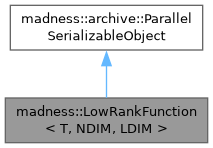
LowRankFunction represents a hi-dimensional (NDIM) function as a sum of products of low-dimensional (LDIM) functions. More...
#include <lowrankfunction.h>
Public Member Functions | |
| LowRankFunction ()=default | |
| LowRankFunction (const LowRankFunction &other) | |
| shallow copy ctor | |
| LowRankFunction (std::vector< Function< T, LDIM > > g, std::vector< Function< T, LDIM > > h, double tol) | |
| void | cloud_load (World &world, const Cloud &cloud, Recordlist< Cloud::keyT > &recordlist) |
| customized function to load this from the cloud | |
| Recordlist< Cloud::keyT > | cloud_store (World &world, Cloud &cloud) const |
| customized function to store this to the cloud | |
| std::vector< Function< T, LDIM > > | get_functions (const particle< LDIM > &p) const |
| std::vector< Function< T, LDIM > > | get_g () const |
| std::vector< Function< T, LDIM > > | get_h () const |
| double | l2error (const LRFunctorBase< T, NDIM > &lrfunctor1) const |
| compute the l2 error |functor - \sum_i g_ih_i|_2 | |
| double | l2error_pythagoras (double f_norm_sq) const |
| TensorTypeData< T >::scalar_type | norm2 () const |
| l2 norm | |
| T | operator() (const Vector< double, NDIM > &r) const |
| function evaluation | |
| template<typename Q> | |
| LowRankFunction | operator* (const Q a) const |
| scale by a scalar | |
| LowRankFunction | operator* (const T a) const |
| out-of-place scale by a scalar (no type conversion) | |
| LowRankFunction & | operator*= (const T a) |
| in-place scale by a scalar (no type conversion) | |
| LowRankFunction | operator+ (const LowRankFunction &b) const |
| addition | |
| LowRankFunction & | operator+= (const LowRankFunction &b) |
| in-place addition | |
| LowRankFunction | operator- (const LowRankFunction &b) const |
| subtraction | |
| LowRankFunction & | operator-= (const LowRankFunction &b) |
| in-place subtraction | |
| LowRankFunction & | operator= (const LowRankFunction &f) |
| void | optimize (const LRFunctorBase< T, NDIM > &lrfunctor1, const long nopt=1) |
| optimize the lrf using the lrfunctor | |
| void | print_size (std::string msg="") const |
| Tensor< long > | rank () const |
| Function< T, NDIM > | reconstruct () const |
| f(1,2) = \sum_i g_i(1) h_i(2) | |
| void | remove_linear_dependencies (double tol=-1.0) |
| void | reorthonormalize () |
| template<typename Archive> | |
| void | serialize (const Archive &ar) |
| serialize to an archive (e.g. cloud or file) | |
| double | size () const |
| return the size in GByte | |
| World & | world () const |
Static Public Member Functions | |
| static std::tuple< std::vector< Function< T, LDIM > >, Tensor< T >, Tensor< T > > | rr_cholesky_matrix_and_reorder (const std::vector< Function< T, LDIM > > &v, Tensor< T > ovlp, const double tol) |
Public Attributes | |
| bool | do_print =false |
| std::vector< Function< T, LDIM > > | g |
| std::vector< Function< T, LDIM > > | h |
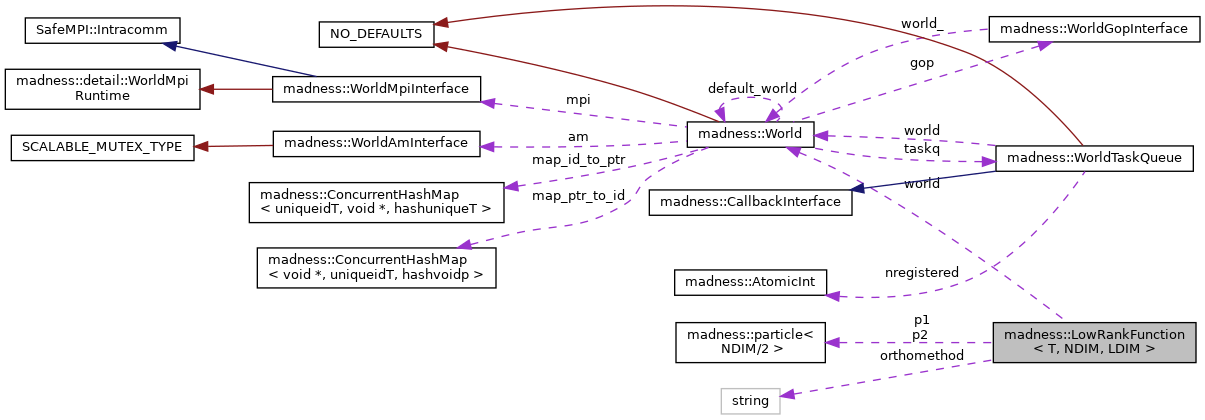
| const particle< LDIM > | p1 =particle<LDIM>::particle1() |
| const particle< LDIM > | p2 =particle<LDIM>::particle2() |
| double | rank_revealing_tol =1.e-8 |
Private Member Functions | |
| std::vector< Function< T, LDIM > > | orthonormalize (const std::vector< Function< T, LDIM > > &g) const |
| orthonormalize the argument vector via rank-revealing Cholesky | |
Friends | |
| LowRankFunction | copy (const LowRankFunction &other) |
| deep copy | |
| hashT | hash_value (const LowRankFunction< T, NDIM > &f) |
| LowRankFunction | operator* (const T a, const LowRankFunction &other) |
| multiplication with a scalar | |
Detailed Description
class madness::LowRankFunction< T, NDIM, LDIM >
LowRankFunction represents a hi-dimensional (NDIM) function as a sum of products of low-dimensional (LDIM) functions.
a LowRankFunction can be created from a hi-dim function directly, or from a composite like f(1,2) phi(1) psi(2), where f(1,2) is a two-particle function (e.g. a Slater function) the representation is canonical: f(1,2) = \sum_i g_i(1) h_i(2) for the time being we don't require g or h to be orthogonal or normalized
Constructor & Destructor Documentation
◆ LowRankFunction() [1/3]
|
default |
Referenced by LowRankFunction(), copy, hash_value, operator*(), operator*(), operator*, operator*=(), operator+(), operator+=(), operator-(), operator-=(), and operator=().
◆ LowRankFunction() [2/3]
|
inline |
References g, h, MADNESS_CHECK_THROW, and rank_revealing_tol.
◆ LowRankFunction() [3/3]
|
inline |
shallow copy ctor
References LowRankFunction(), g, h, and rank_revealing_tol.
Member Function Documentation
◆ cloud_load()
|
inline |
customized function to load this from the cloud
- Parameters
-
[in,out] recordlist containing the keys of the member variables -> will be reduced by the keys which are used
References madness::Cloud::forward_load(), g, h, rank_revealing_tol, and world().
◆ cloud_store()
|
inline |
customized function to store this to the cloud
will store g and h elements individually
References g, h, rank_revealing_tol, madness::Cloud::store(), and world().
◆ get_functions()
|
inline |
References g, h, MADNESS_CHECK, and p().
◆ get_g()
|
inline |
References g.
Referenced by madness::CCPairFunction< T, NDIM >::op_dec_to_dec(), madness::CCPairFunction< T, NDIM >::remove_linearly_dependent_terms(), and test_recursive_apply().
◆ get_h()
|
inline |
References h.
Referenced by madness::CCPairFunction< T, NDIM >::op_dec_to_dec(), madness::CCPairFunction< T, NDIM >::remove_linearly_dependent_terms(), and test_recursive_apply().
◆ l2error()
|
inline |
compute the l2 error |functor - \sum_i g_ih_i|_2
\int (f(1,2) - gh(1,2))^2 = \int f(1,2)^2 - 2\int f(1,2) gh(1,2) + \int gh(1,2)^2 since we are subtracting large numbers the numerics are sensitive, and NaN may be returned..
References madness::arg(), do_print, madness::timer::do_print, madness::error(), g, h, inner(), madness::inner(), matrix_inner(), madness::LRFunctorBase< T, NDIM, LDIM >::norm2(), p1, p2, print(), rank(), madness::timer::tag(), and world().
◆ l2error_pythagoras()
|
inline |
Cheap relative L2 error via Pythagoras (canonical form only).
When h is orthonormal AND g is the reprojection of h (g_k = <f(r1,r2) | h_k(r2)>_{r2}), the following identity holds: ||f - sum_k g_k h_k||^2 = ||f||^2 - sum_k ||g_k||^2 (cross and self terms collapse to the same sum_k ||g_k||^2). No functor applications are needed — only norms of the stored g.
- Parameters
-
[in] f_norm_sq precomputed ||f||^2 (typically lrfunctor.norm2()^2)
- Precondition
- the LRF is in canonical form and g holds the reprojected factors.
References madness::arg(), g, MADNESS_CHECK_THROW, and madness::norm2s().
Referenced by madness::LowRankFunctionFactory< T, NDIM, LDIM >::project_stable().
◆ norm2()
|
inline |
l2 norm
References g, h, matrix_inner(), and world().
◆ operator()()
|
inline |
◆ operator*() [1/2]
|
inline |
scale by a scalar
References LowRankFunction(), a, g, h, NDIM, Q(), and rank_revealing_tol.
◆ operator*() [2/2]
|
inline |
out-of-place scale by a scalar (no type conversion)
References LowRankFunction(), a, g, h, and rank_revealing_tol.
◆ operator*=()
|
inline |
in-place scale by a scalar (no type conversion)
References LowRankFunction(), a, and g.
◆ operator+()
|
inline |
addition
References LowRankFunction(), b, and copy().
◆ operator+=()
|
inline |
in-place addition
References LowRankFunction(), madness::append(), b, copy(), g, and h.
◆ operator-()
|
inline |
subtraction
References LowRankFunction(), b, and copy().
◆ operator-=()
|
inline |
in-place subtraction
References LowRankFunction(), madness::append(), b, copy(), g, and h.
◆ operator=()
|
inline |
References LowRankFunction(), do_print, madness::f, g, h, and rank_revealing_tol.
◆ optimize()
|
inline |
optimize the lrf using the lrfunctor
- Parameters
-
[in] nopt number of iterations (wrt to Alg. 4.3 in Halko)
References do_print, madness::timer::do_print, g, h, inner(), orthonormalize(), p1, p2, madness::timer::tag(), truncate(), and world().
Referenced by madness::CCPairFunction< T, NDIM >::op_dec_to_dec().
◆ orthonormalize()
|
inlineprivate |
orthonormalize the argument vector via rank-revealing Cholesky
References g, g2(), madness::FunctionDefaults< NDIM >::get_thresh(), matrix_inner(), madness::orthonormalize_rrcd(), rank_revealing_tol, and truncate().
◆ print_size()
|
inline |
◆ rank()
|
inline |
References g, h, and MADNESS_ASSERT.
Referenced by l2error(), print_size(), and rr_cholesky_matrix_and_reorder().
◆ reconstruct()
|
inline |
f(1,2) = \sum_i g_i(1) h_i(2)
References g, h, madness::hartree_product(), and MADNESS_ASSERT.
Referenced by test_recursive_apply().
◆ remove_linear_dependencies()
|
inline |
remove linear dependencies in g and h; result stays in canonical form f(1,2) = \sum_i g_i(1) h_i(2) {g} and {h} are not necessarily orthogonal, but they are linearly independent
References g, h, inner(), matrix_inner(), rank_revealing_tol, rr_cholesky_matrix_and_reorder(), transform(), and world().
Referenced by reorthonormalize().
◆ reorthonormalize()
|
inline |
References remove_linear_dependencies().
Referenced by madness::CCPairFunction< T, NDIM >::remove_linearly_dependent_terms().
◆ rr_cholesky_matrix_and_reorder()
|
inlinestatic |
perform RRCD on the overlap matrix of the functions, reorder the functions according to the pivoting, and return the upper triangular matrix from the Cholesky decomposition note: the rr_cholesky is more efficient than a full SVD for removing linear dependencies, but it does not give an orthonormal basis, so an additional orthonormalization step is needed if orthogonality is desired. To orthonormalize: auto [pv, X] = rr_cholesky_matrix_and_reorder(v,ovlp,tol); v_ortho=transform(world,pv,X); // v_ortho_i = sum_j v_j U_{ji}^(-1)
- Parameters
-
[in] v the input functions [in] ovlp the overlap matrix of the input functions, will be destroyed in-place by the rr_cholesky [in] tol the tolerance for linear dependence in the rr_cholesky
- Returns
- a tuple containing pv: reordered original, linearly-independent functions, X: the (r,r) transformation matrix from pv to orthonormalized functions: v_ortho_i = v_p X_pi = pv_j X_ji X_inv: its (r,p) "inverse" from original functions to orthonormalized functions: v_p = v_ortho_i X_inv_ip note that X is not the inverse of X_inv, that would be X_full but v_p(x) = pv_i(x) X_ij X_inv_jp is numerically the same
References madness::_(), copy(), madness::BaseTensor::dim(), madness::inverse(), rank(), madness::rr_cholesky(), and v.
Referenced by madness::LowRankFunctionFactory< T, NDIM, LDIM >::project_from_Y_stable(), madness::LowRankFunctionFactory< T, NDIM, LDIM >::project_stable(), and remove_linear_dependencies().
◆ serialize()
|
inline |
serialize to an archive (e.g. cloud or file)
References e(), g, h, MADNESS_EXCEPTION, and rank_revealing_tol.
◆ size()
|
inline |
return the size in GByte
References g, madness::get_size(), h, and world().
Referenced by print_size().
◆ world()
|
inline |
References g, and MADNESS_CHECK_THROW.
Referenced by cloud_load(), cloud_store(), l2error(), norm2(), optimize(), print_size(), remove_linear_dependencies(), and size().
Friends And Related Symbol Documentation
◆ copy
|
friend |
deep copy
References LowRankFunction(), madness::copy(), g, h, and rank_revealing_tol.
◆ hash_value
|
friend |
References LowRankFunction(), aa, madness::f, madness::hash_combine(), and hash_value().
◆ operator*
|
friend |
multiplication with a scalar
References LowRankFunction(), and a.
Member Data Documentation
◆ do_print
| bool madness::LowRankFunction< T, NDIM, LDIM >::do_print =false |
Referenced by l2error(), operator=(), and optimize().
◆ g
| std::vector<Function<T,LDIM> > madness::LowRankFunction< T, NDIM, LDIM >::g |
Referenced by LowRankFunction(), LowRankFunction(), cloud_load(), cloud_store(), copy, get_functions(), get_g(), madness::inner(), l2error(), l2error_pythagoras(), norm2(), operator()(), operator*(), operator*(), operator*=(), operator+=(), operator-=(), operator=(), optimize(), orthonormalize(), print_size(), rank(), reconstruct(), remove_linear_dependencies(), serialize(), size(), and world().
◆ h
| std::vector<Function<T,LDIM> > madness::LowRankFunction< T, NDIM, LDIM >::h |
Referenced by LowRankFunction(), LowRankFunction(), cloud_load(), cloud_store(), copy, get_functions(), get_h(), madness::inner(), l2error(), norm2(), operator()(), operator*(), operator*(), operator+=(), operator-=(), operator=(), optimize(), rank(), reconstruct(), remove_linear_dependencies(), serialize(), and size().
◆ p1
| const particle<LDIM> madness::LowRankFunction< T, NDIM, LDIM >::p1 =particle<LDIM>::particle1() |
Referenced by l2error(), and optimize().
◆ p2
| const particle<LDIM> madness::LowRankFunction< T, NDIM, LDIM >::p2 =particle<LDIM>::particle2() |
Referenced by l2error(), and optimize().
◆ rank_revealing_tol
| double madness::LowRankFunction< T, NDIM, LDIM >::rank_revealing_tol =1.e-8 |
Referenced by LowRankFunction(), LowRankFunction(), cloud_load(), cloud_store(), copy, operator*(), operator*(), operator=(), orthonormalize(), remove_linear_dependencies(), and serialize().
The documentation for this class was generated from the following file:
Generated on for MADNESS by
 1.15.0