operator class for the handling of DFT exchange-correlation functionals More...
#include <SCFOperators.h>
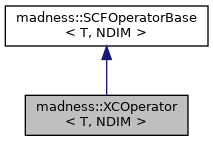
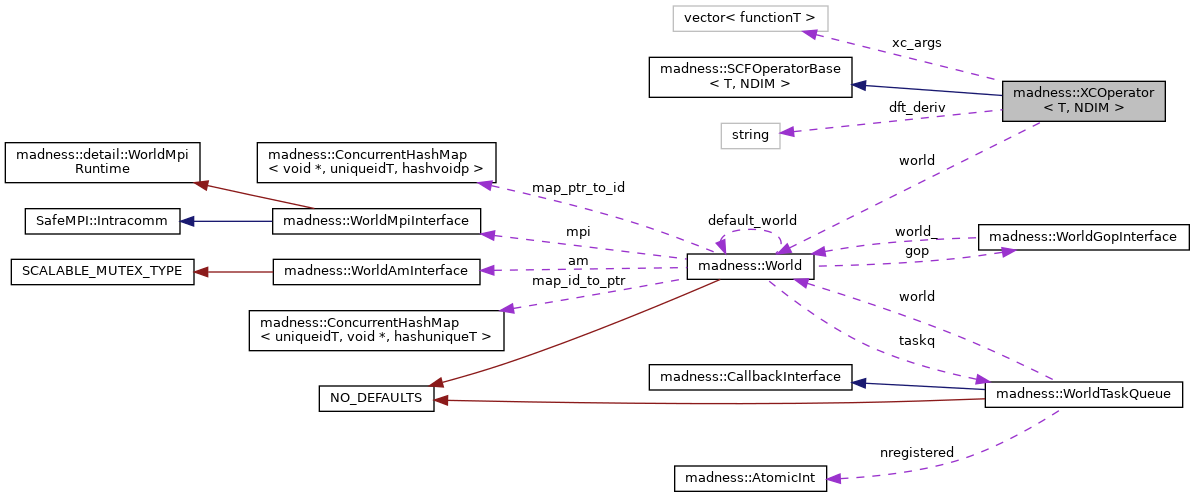
Classes | |
| struct | expme |
| simple structure to take the pointwise exponential of a function, shifted by +14 More... | |
| struct | logme |
| simple structure to take the pointwise logarithm of a function, shifted by +14 More... | |
Public Types | |
| enum class | TauU1 { mra , pointwise } |
| compute the kinetic energy density and add it to the intermediates More... | |
 Public Types inherited from madness::SCFOperatorBase< T, NDIM > Public Types inherited from madness::SCFOperatorBase< T, NDIM > | |
| typedef Function< T, NDIM > | functionT |
| typedef Tensor< T > | tensorT |
| typedef std::vector< functionT > | vecfuncT |
Public Member Functions | |
| XCOperator (World &world) | |
| default ctor without information about the XC functional | |
| XCOperator (World &world, const Nemo *nemo, int ispin=0) | |
| ctor with a Nemo calculation, will initialize the necessary intermediates | |
| XCOperator (World &world, const Nemo *scf, const real_function_3d &arho, const real_function_3d &brho, int ispin=0) | |
| ctor with an Nemo calculation, will initialize the necessary intermediates | |
| XCOperator (World &world, const SCF *scf, const real_function_3d &arho, const real_function_3d &brho, int ispin=0, std::string deriv="abgv") | |
| ctor with an SCF calculation, will initialize the necessary intermediates | |
| XCOperator (World &world, const SCF *scf, int ispin=0, std::string deriv="abgv") | |
| ctor with an SCF calculation, will initialize the necessary intermediates | |
| XCOperator (World &world, std::shared_ptr< XCfunctional > xc, const bool spin_polarized, int ispin, int nbeta, const real_function_3d &arho, const real_function_3d &brho, std::string deriv="abgv") | |
| custom ctor with the XC functional | |
| XCOperator (World &world, std::string xc_data, const bool spin_polarized, const real_function_3d &arho, const real_function_3d &brho, std::shared_ptr< NuclearCorrelationFactor > ncf_, const real_function_3d &arho_reg_, const real_function_3d &brho_reg_, std::string deriv="abgv") | |
| ctor for the regularized (nemo) path, without a Nemo object | |
| XCOperator (World &world, std::string xc_data, const bool spin_polarized, const real_function_3d &arho, const real_function_3d &brho, std::string deriv="abgv") | |
| custom ctor with information about the XC functional | |
| XCOperator & | allow_weak_form () |
opt in to the weak form, if the xc_weak_gga parameter asks for it | |
| std::vector< Function< T, NDIM > > | apply_tau_term (const std::vector< Function< T, NDIM > > &vket) const |
| apply the non-multiplicative meta-gga term on a set of orbitals | |
| real_function_3d | apply_xc_kernel (const real_function_3d &density, const vecfuncT grad_dens_pt=vecfuncT()) const |
| construct the xc kernel and apply it directly on the (response) density | |
| double | compute_xc_energy () const |
| compute the xc energy using the precomputed intermediates vf and delrho | |
| const vecfuncT & | get_semilocal_flux () const |
| the semilocal flux X = 2 (de/dsigma_ss) grad(rho_s) + (de/dsigma_ab) grad(rho_s') | |
| real_function_3d | get_tau (const int spin=0) const |
| the kinetic energy density of one spin channel, as set by set_tau() | |
| real_function_3d | get_vlocal () const |
| the multiplicative part of the potential, as make_xc_potential() returned it | |
| real_function_3d | get_vtau () const |
| de/dtau, as computed by make_xc_potential() | |
| bool | has_tau_term () const |
| true if the functional contributes a non-multiplicative (meta-gga) term | |
| std::string | info () const |
| print some information about this operator | |
| bool | is_weak_form () const |
| real_function_3d | make_xc_potential () const |
| return the local xc potential | |
| T | operator() (const Function< T, NDIM > &bra, const Function< T, NDIM > &ket) const |
| the xc contribution to the Fock matrix, as a matrix element | |
| Function< T, NDIM > | operator() (const Function< T, NDIM > &ket) const |
| apply the xc potential on an orbitals | |
| Tensor< T > | operator() (const std::vector< Function< T, NDIM > > &vbra, const std::vector< Function< T, NDIM > > &vket) const |
| the xc contribution to the Fock matrix | |
| std::vector< Function< T, NDIM > > | operator() (const std::vector< Function< T, NDIM > > &vket) const |
| apply the xc potential on a set of orbitals | |
| XCOperator & | set_extra_truncation (const double &fac) |
| void | set_ispin (const int i) const |
| set the spin state this operator is acting on | |
| XCOperator & | set_print_level (const int p) |
| print the meta-gga de/dtau range each time the operator is applied | |
| void | set_tau (const vecfuncT &amo, const Tensor< double > &aocc, const vecfuncT &bmo=vecfuncT(), const Tensor< double > &bocc=Tensor< double >(), const TauU1 u1mode=TauU1::pointwise) const |
| compute tau = 1/2 sum_i |grad psi_i|^2 and store it in the intermediates | |
| XCOperator & | set_weak_gga (const bool flag) |
| override CalculationParameters::xc_weak_gga(), for callers without one | |
| void | weak_xc_terms (const std::vector< Function< T, NDIM > > &vket, std::vector< Function< T, NDIM > > &mult, std::vector< std::vector< Function< T, NDIM > > > &flux) const |
| weak-form split of the non-multiplicative xc terms | |
| Public Member Functions inherited from madness::SCFOperatorBase< T, NDIM > | |
| SCFOperatorBase ()=default | |
| SCFOperatorBase (std::shared_ptr< MacroTaskQ > taskq) | |
| virtual | ~SCFOperatorBase () |
| virtual tensorT | operator() (const vecfuncT &vbra, const vecfuncT &vket) const =0 |
| compute the matrix <vbra | op | vket> | |
| virtual vecfuncT | operator() (const vecfuncT &vket) const =0 |
| apply this operator on the argument vector of functions | |
Public Attributes | |
| std::shared_ptr< XCfunctional > | xc |
| interface to the actual XC functionals | |
| Public Attributes inherited from madness::SCFOperatorBase< T, NDIM > | |
| nlohmann::json | statistics |
| std::shared_ptr< MacroTaskQ > | taskq =0 |
Private Member Functions | |
| real_function_3d | div_dft_deriv (const vecfuncT &v) const |
| divergence of a vector field, honouring dft_deriv | |
| bool | has_tau_args () const |
| true once set_tau() has supplied tau, by either route | |
| bool | is_initialized () const |
| check if the intermediates are initialized | |
| std::shared_ptr< Derivative< T, NDIM > > | make_derivative (const int axis) const |
| gradient operator honouring dft_deriv, for the meta-gga term | |
| nemo_u1_functors | make_u1_functors () const |
| the four analytic U1 quantities the xc ops evaluate pointwise | |
| real_function_3d | make_xc_potential_impl () const |
| the body of make_xc_potential(); the wrapper only stashes vlocal | |
| vecfuncT | prep_xc_args (const real_function_3d &arho, const real_function_3d &brho, const real_function_3d &arho_reg=real_function_3d(), const real_function_3d &brho_reg=real_function_3d()) const |
| compute the intermediates for the XC functionals | |
| void | prep_xc_args_response (const real_function_3d &dens_pt, vecfuncT &xc_args, vecfuncT &ddens_pt) const |
| compute the intermediates for the XC functionals | |
Private Attributes | |
| std::string | dft_deriv |
| which derivative operator to use | |
| double | extra_truncation |
| additional truncation for the densities in the XC kernel | |
| int | ispin |
| the XC functionals depend on the spin of the orbitals they act on | |
| int | nbeta |
| number of beta orbitals | |
| std::shared_ptr< NuclearCorrelationFactor > | ncf |
| the nuclear correlation factor, if it exists, for computing derivatives for GGA | |
| int | print_level =0 |
| print level; >=2 logs the meta-gga de/dtau range | |
| vecfuncT | semilocal_flux |
| the semilocal flux, assigned by make_xc_potential() in weak form only | |
| real_function_3d | vlocal |
| the multiplicative potential, stashed by make_xc_potential() | |
| real_function_3d | vtau |
| de/dtau, the prefactor of the non-multiplicative meta-gga term | |
| bool | weak_form_ok =false |
| caller has opted in to the weak form, see allow_weak_form() | |
| bool | weak_gga =false |
| the user asked for the weak form: CalculationParameters::xc_weak_gga() | |
| World & | world |
| the world | |
| vecfuncT | xc_args |
| functions that are need for the computation of the XC operator | |
Detailed Description
class madness::XCOperator< T, NDIM >
operator class for the handling of DFT exchange-correlation functionals
Member Enumeration Documentation
◆ TauU1
|
strong |
compute the kinetic energy density and add it to the intermediates
tau is orbital-dependent, so unlike the density it cannot be recovered from what the ctors are given – it has to be supplied separately. Call this after construction and before make_xc_potential() whenever has_tau_term() is true; make_xc_potential() throws otherwise. The occupation numbers are required, not optional: amo/bmo may carry virtual orbitals (occupation zero), which contribute nothing to the density but would inflate an unweighted sum of |grad psi|^2, and occupations may be fractional.
- Parameters
-
[in] amo alpha orbitals (nemos if a nuclear correlation factor is set) [in] aocc occupation numbers of amo [in] bmo beta orbitals, ignored if the calculation is spin-restricted [in] bocc occupation numbers of bmo how the two U1 terms of tau's product rule are evaluated U1 = -grad(R)/R is analytic but componentwise non-smooth at each nucleus (U1_x ~ x/r), so carrying it as an MRA Function costs depth ~18 and every product with it inherits that depth – which refine_to_common_level then imposes on every xc intermediate.
| Enumerator | |
|---|---|
| mra | U1 and |U1|^2 projected into Functions and multiplied. |
| pointwise | U1 evaluated from its functor at the orbital tree's quadrature points; nothing involving it is projected |
Constructor & Destructor Documentation
◆ XCOperator() [1/8]
|
inline |
default ctor without information about the XC functional
◆ XCOperator() [2/8]
| madness::XCOperator< T, NDIM >::XCOperator | ( | World & | world, |
| std::string | xc_data, | ||
| const bool | spin_polarized, | ||
| const real_function_3d & | arho, | ||
| const real_function_3d & | brho, | ||
| std::string | deriv = "abgv" |
||
| ) |
custom ctor with information about the XC functional
References madness::XCOperator< T, NDIM >::nbeta, madness::Function< T, NDIM >::norm2(), madness::XCOperator< T, NDIM >::prep_xc_args(), madness::XCOperator< T, NDIM >::world, madness::XCOperator< T, NDIM >::xc, and madness::XCOperator< T, NDIM >::xc_args.
◆ XCOperator() [3/8]
| madness::XCOperator< T, NDIM >::XCOperator | ( | World & | world, |
| std::shared_ptr< XCfunctional > | xc, | ||
| const bool | spin_polarized, | ||
| int | ispin, | ||
| int | nbeta, | ||
| const real_function_3d & | arho, | ||
| const real_function_3d & | brho, | ||
| std::string | deriv = "abgv" |
||
| ) |
custom ctor with the XC functional
References madness::XCOperator< T, NDIM >::prep_xc_args(), and madness::XCOperator< T, NDIM >::xc_args.
◆ XCOperator() [4/8]
| madness::XCOperator< T, NDIM >::XCOperator | ( | World & | world, |
| const SCF * | scf, | ||
| int | ispin = 0, |
||
| std::string | deriv = "abgv" |
||
| ) |
ctor with an SCF calculation, will initialize the necessary intermediates
References madness::SCF::amo, madness::SCF::aocc, madness::SCF::bmo, madness::SCF::bocc, madness::SCF::make_density(), madness::CalculationParameters::nbeta(), madness::XCOperator< T, NDIM >::nbeta, madness::SCF::param, madness::CalculationParameters::spin_restricted(), madness::XCOperator< T, NDIM >::world, madness::CalculationParameters::xc(), and madness::XCOperator< T, NDIM >::xc.
◆ XCOperator() [5/8]
| madness::XCOperator< T, NDIM >::XCOperator | ( | World & | world, |
| const Nemo * | nemo, | ||
| int | ispin = 0 |
||
| ) |
ctor with a Nemo calculation, will initialize the necessary intermediates
References madness::nemo, madness::XCOperator< T, NDIM >::weak_gga, madness::XCOperator< T, NDIM >::world, and madness::XCOperator< T, NDIM >::xc.
◆ XCOperator() [6/8]
| madness::XCOperator< T, NDIM >::XCOperator | ( | World & | world, |
| std::string | xc_data, | ||
| const bool | spin_polarized, | ||
| const real_function_3d & | arho, | ||
| const real_function_3d & | brho, | ||
| std::shared_ptr< NuclearCorrelationFactor > | ncf_, | ||
| const real_function_3d & | arho_reg_, | ||
| const real_function_3d & | brho_reg_, | ||
| std::string | deriv = "abgv" |
||
| ) |
ctor for the regularized (nemo) path, without a Nemo object
custom ctor for the regularized (nemo) path, without a Nemo object
- Parameters
-
[in] arho,brho the physical densities rho_s [in] ncf_ the nuclear correlation factor [in] arho_reg,brho_reg the regularized densities rho_s/R^2, which let prep_xc_args build zeta without putting the nuclear cusp under a numerical derivative
References madness::XCOperator< T, NDIM >::nbeta, madness::Function< T, NDIM >::norm2(), madness::XCOperator< T, NDIM >::prep_xc_args(), madness::XCOperator< T, NDIM >::world, madness::XCOperator< T, NDIM >::xc, and madness::XCOperator< T, NDIM >::xc_args.
◆ XCOperator() [7/8]
| madness::XCOperator< T, NDIM >::XCOperator | ( | World & | world, |
| const SCF * | scf, | ||
| const real_function_3d & | arho, | ||
| const real_function_3d & | brho, | ||
| int | ispin = 0, |
||
| std::string | deriv = "abgv" |
||
| ) |
ctor with an SCF calculation, will initialize the necessary intermediates
References madness::SCF::param, madness::XCOperator< T, NDIM >::prep_xc_args(), madness::CalculationParameters::spin_restricted(), madness::XCOperator< T, NDIM >::world, madness::CalculationParameters::xc(), madness::XCOperator< T, NDIM >::xc, and madness::XCOperator< T, NDIM >::xc_args.
◆ XCOperator() [8/8]
| madness::XCOperator< T, NDIM >::XCOperator | ( | World & | world, |
| const Nemo * | scf, | ||
| const real_function_3d & | arho, | ||
| const real_function_3d & | brho, | ||
| int | ispin = 0 |
||
| ) |
ctor with an Nemo calculation, will initialize the necessary intermediates
Member Function Documentation
◆ allow_weak_form()
|
inline |
opt in to the weak form, if the xc_weak_gga parameter asks for it
Load-bearing: in weak form make_xc_potential() returns only de/drho, so a caller that does not also apply weak_xc_terms() and add the matrix form's contribution (operator()(vbra,vket)) would silently drop the whole semilocal contribution and return a plausible but wrong energy. Only Nemo::compute_nemo_potentials implements the split, so only it opts in; SCF, OEP, TDHF and the response kernels keep the multiplicative potential.
References madness::XCOperator< T, NDIM >::weak_form_ok.
Referenced by madness::Nemo::compute_nemo_potentials_impl(), and test_XCOperator_matrix().
◆ apply_tau_term()
| std::vector< Function< T, NDIM > > madness::XCOperator< T, NDIM >::apply_tau_term | ( | const std::vector< Function< T, NDIM > > & | vket | ) | const |
apply the non-multiplicative meta-gga term on a set of orbitals
apply the non-multiplicative meta-gga term, -1/2 sum_x D_x(vtau D_x psi_i)
![\[
\hat v_\tau \psi_i = -\frac{1}{2}\nabla\cdot
\left(\frac{\partial e_{xc}}{\partial\tau_\sigma}\nabla\psi_i\right)
\]](form_350_dark.png)
evaluated as 


References madness::add(), madness::apply(), axis, madness::FunctionDefaults< NDIM >::get_cell_width(), madness::FunctionDefaults< NDIM >::get_thresh(), L, lo, MADNESS_CHECK_THROW, madness::Tensor< T >::max(), madness::mul(), madness::mul_sparse(), madness::print(), madness::World::rank(), madness::refine(), madness::scale(), madness::World::size(), madness::sub(), madness::truncate(), and v.
Referenced by madness::Nemo::compute_nemo_potentials_impl().
◆ apply_xc_kernel()
| real_function_3d madness::XCOperator< T, NDIM >::apply_xc_kernel | ( | const real_function_3d & | dens_pt, |
| const vecfuncT | grad_dens_pt = vecfuncT() |
||
| ) | const |
construct the xc kernel and apply it directly on the (response) density
apply the xc kernel on a perturbed density
the xc kernel is the second derivative of the xc functions wrt the density
- Parameters
-
[in] density the (response) density on which the kernel is applied
- Returns
- kernel * density
cf Eq. (13) of T. Yanai, R. J. Harrison, and N. Handy, “Multiresolution quantum chemistry in multiwavelet bases: time-dependent density functional theory with asymptotically corrected potentials in local density and generalized gradient approximations,” Mol. Phys., vol. 103, no. 2, pp. 413–424, 2005.
the application of the xc kernel is (RHF only)
![\[
\frac{\partial^2E_{xc}}{\partial \rho_\alpha^2}\circ\tilde\rho
= second_{local} + second_{semilocal} + first_{semilocal}
\]](form_346_dark.png)
where the second partial derivatives are
![\[
second_{local} = \frac{\partial^2 f_{xc}}{\partial \rho_\alpha^2}\tilde \rho
+ 2\frac{\partial^2 f_{xc}}{\partial \rho_\alpha\sigma_{\alpha\alpha}}
\left(\vec\nabla \rho_a\cdot \vec \nabla\tilde\rho\right)
\]](form_347_dark.png)
the second partial derivatives that need to be multiplied with the density gradients
![\[
second_{semilocal} = -\vec\nabla\cdot\left((\vec\nabla\rho)
\left[2\frac{\partial^2 f_{xc}}{\partial\rho_\alpha\partial\sigma_{\alpha\alpha}}\tilde\rho
+ 4\frac{\partial^2 f_{xc}}{\partial\sigma_{\alpha\alpha}^2}
\left(\vec\nabla\rho_\alpha\cdot\vec\nabla\tilde\rho\right)\right]\right)
\]](form_348_dark.png)
and the first derivatives that need to be multiplied with the density gradients
![\[
first_{semilocal} =
-\vec\nabla\cdot\left(2\frac{\partial f_{xc}}{\partial\sigma_{\alpha\alpha}}\vec\nabla\tilde\rho\right)
\]](form_349_dark.png)
References madness::XCfunctional::is_gga(), madness::XCfunctional::is_spin_polarized(), MADNESS_ASSERT, MADNESS_EXCEPTION, madness::multi_to_multi_op_values(), op(), madness::refine_to_common_level(), madness::Function< T, NDIM >::truncate(), madness::truncate(), and xc.
◆ compute_xc_energy()
| double madness::XCOperator< T, NDIM >::compute_xc_energy | ( | ) | const |
compute the xc energy using the precomputed intermediates vf and delrho
References MADNESS_EXCEPTION, madness::refine_to_common_level(), madness::Function< T, NDIM >::trace(), madness::truncate(), and xc.
Referenced by madness::Nemo::compute_energy_regularized(), and test_XCOperator().
◆ div_dft_deriv()
|
private |
divergence of a vector field, honouring dft_deriv
divergence of a real vector field, honouring dft_deriv
vmra.h's div() is div_abgv(), so a caller that has selected dft_deriv bspline/ble has to name the matching derivative explicitly.
References madness::div_deriv(), and v.
◆ get_semilocal_flux()
|
inline |
the semilocal flux X = 2 (de/dsigma_ss) grad(rho_s) + (de/dsigma_ab) grad(rho_s')
Only assigned in weak form, by make_xc_potential(). Same-spin and cross-spin contributions are summed: they enter as a single divergence.
References madness::XCOperator< T, NDIM >::semilocal_flux.
◆ get_tau()
| real_function_3d madness::XCOperator< T, NDIM >::get_tau | ( | const int | spin = 0 | ) | const |
the kinetic energy density of one spin channel, as set by set_tau()
exposed for diagnostics and for the exact check int(tau) == T
References madness::XCfunctional::enum_taua, and madness::XCfunctional::enum_taub.
Referenced by test_meta_gga().
◆ get_vlocal()
|
inline |
the multiplicative part of the potential, as make_xc_potential() returned it
References madness::XCOperator< T, NDIM >::vlocal.
◆ get_vtau()
|
inline |
de/dtau, as computed by make_xc_potential()
References madness::XCOperator< T, NDIM >::vtau.
◆ has_tau_args()
|
private |
true once set_tau() has supplied tau, by either route
References madness::XCfunctional::enum_gradfa, madness::XCfunctional::enum_nemo_R2, and madness::XCfunctional::enum_taua.
◆ has_tau_term()
| bool madness::XCOperator< T, NDIM >::has_tau_term | ( | ) | const |
true if the functional contributes a non-multiplicative (meta-gga) term
References madness::XCfunctional::needs_tau(), and xc.
Referenced by madness::Nemo::compute_energy_regularized(), madness::Nemo::compute_nemo_potentials_impl(), and madness::Nemo::make_fock_operator().
◆ info()
|
inlinevirtual |
print some information about this operator
Implements madness::SCFOperatorBase< T, NDIM >.
◆ is_initialized()
|
inlineprivate |
check if the intermediates are initialized
References madness::XCOperator< T, NDIM >::xc_args.
◆ is_weak_form()
| bool madness::XCOperator< T, NDIM >::is_weak_form | ( | ) | const |
true if this operator is running in weak form, i.e. make_xc_potential() returns only de/drho and the flux is carried separately Requires both the caller's allow_weak_form() opt-in and the user's xc_weak_gga parameter. A functional with no sigma dependence has no flux, so it is never in weak form either.
Why it exists: the semilocal potential is -div(X) with X = 2 de/dsigma grad(rho), and X has a jump at every nucleus (zeta = grad log rho -> -2Z r_hat, whose Cartesian components flip sign across the origin). Differentiating that jump is what produces the +-8e4 excursions, and no rearrangement of the multiplicative form avoids it, because div(X) is a derivative of X.
The weak form never differentiates X: <phi|v|psi> = int (df/drho) phi psi + int X . grad(phi psi) and in a Green's-function code the same holds for the orbital update, because a radial convolution commutes with the gradient: G * (psi div X) = div(G * (X psi)) - G * (X . grad psi) so the divergence acts on G*(X psi), which is C^1, and the jump is only ever convolved. Same for the meta-gga term -1/2 div(v_tau grad psi).
References madness::XCfunctional::needs_sigma(), and xc.
Referenced by madness::Nemo::compute_nemo_potentials_impl(), and test_XCOperator_matrix().
◆ make_derivative()
|
private |
gradient operator honouring dft_deriv, for the meta-gga term
gradient operator for the meta-gga term, honouring dft_deriv
References axis.
◆ make_u1_functors()
|
private |
the four analytic U1 quantities the xc ops evaluate pointwise
Empty unless the pointwise route is in use. They are handed to the op rather than projected into xc_args precisely because a projected product with U1 is what rings; see nemo_u1_functors.
References axis, madness::XCfunctional::enum_gradfa, and madness::f.
◆ make_xc_potential()
| real_function_3d madness::XCOperator< T, NDIM >::make_xc_potential | ( | ) | const |
return the local xc potential
A thin wrapper whose only job is to stash the result: operator()(vbra,vket) needs whatever the caller got, with no argument to receive it through.
Referenced by madness::Nemo::compute_nemo_potentials_impl(), madness::Nemo::make_fock_operator(), and test_XCOperator().
◆ make_xc_potential_impl()
|
private |
the body of make_xc_potential(); the wrapper only stashes vlocal
References madness::copy(), madness::XCfunctional::is_spin_polarized(), MADNESS_EXCEPTION, madness::multi_to_multi_op_values(), madness::XCfunctional::needs_sigma(), op(), madness::refine_to_common_level(), madness::Function< T, NDIM >::truncate(), madness::truncate(), and xc.
◆ operator()() [1/4]
|
inlinevirtual |
the xc contribution to the Fock matrix, as a matrix element
The 1x1 case of the vector form below; the same bra convention applies.
Implements madness::SCFOperatorBase< T, NDIM >.
References madness::XCOperator< T, NDIM >::operator()().
◆ operator()() [2/4]
|
inlinevirtual |
apply the xc potential on an orbitals
Implements madness::SCFOperatorBase< T, NDIM >.
References madness::XCOperator< T, NDIM >::operator()().
◆ operator()() [3/4]
| Tensor< T > madness::XCOperator< T, NDIM >::operator() | ( | const std::vector< Function< T, NDIM > > & | vbra, |
| const std::vector< Function< T, NDIM > > & | vket | ||
| ) | const |
the xc contribution to the Fock matrix
With a nuclear correlation factor the bra must carry R^2 – call it as xcoperator(R2nemo, nemo), the way Kinetic is called in Nemo::compute_fock_matrix. Without one, bra and ket are the same orbitals.
See the declaration for the bra convention – vbra carries R^2, vket does not.
References madness::apply(), axis, madness::WorldGopInterface::fence(), madness::FunctionDefaults< NDIM >::get_thresh(), madness::World::gop, MADNESS_CHECK_THROW, madness::matrix_inner(), madness::mul_sparse(), madness::norm2(), one(), thresh, and madness::transpose().
◆ operator()() [4/4]
| std::vector< Function< T, NDIM > > madness::XCOperator< T, NDIM >::operator() | ( | const std::vector< Function< T, NDIM > > & | vket | ) | const |
apply the xc potential on a set of orbitals
References madness::FunctionDefaults< NDIM >::get_thresh(), and madness::mul_sparse().
Referenced by madness::XCOperator< T, NDIM >::operator()(), and madness::XCOperator< T, NDIM >::operator()().
◆ prep_xc_args()
|
private |
compute the intermediates for the XC functionals
prepare xc args
- Parameters
-
[in] arho density of the alpha orbitals [in] brho density of the beta orbitals (necessary only if spin-polarized)
- Returns
- xc_args vector of intermediates as described above compute the intermediates for the XC functionals If the regularized densities are supplied, zeta = grad log(rho) is built as grad log(rho_reg) - 2 U1 – exact, and it keeps the nuclear cusp of rho = R^2 rho_reg out from under the numerical derivative.
References axis, madness::copy(), madness::XCfunctional::enum_rhoa, madness::XCfunctional::enum_rhob, madness::XCfunctional::enum_zetaa_x, madness::XCfunctional::enum_zetaa_y, madness::XCfunctional::enum_zetaa_z, madness::XCfunctional::enum_zetab_x, madness::XCfunctional::enum_zetab_y, madness::XCfunctional::enum_zetab_z, madness::f, madness::WorldGopInterface::fence(), madness::World::gop, madness::grad(), madness::grad_ble_one(), madness::grad_bspline_one(), madness::XCfunctional::is_spin_polarized(), madness::XCfunctional::needs_sigma(), madness::XCfunctional::number_xc_args, madness::Function< T, NDIM >::reconstruct(), madness::truncate(), madness::unary_op(), madness::Function< T, NDIM >::world(), xc, and zeta.
Referenced by madness::XCOperator< T, NDIM >::XCOperator(), madness::XCOperator< T, NDIM >::XCOperator(), madness::XCOperator< T, NDIM >::XCOperator(), and madness::XCOperator< T, NDIM >::XCOperator().
◆ prep_xc_args_response()
|
private |
compute the intermediates for the XC functionals
add intermediates for the response kernels to xc_args
- Parameters
-
[in] dens_pt perturbed densities from CPHF or TDDFT equations [in,out] xc_args vector of intermediates as described above [out] ddens_pt xyz-derivatives of dens_pt
References madness::dot(), madness::XCfunctional::enum_ddens_ptx, madness::XCfunctional::enum_ddens_pty, madness::XCfunctional::enum_ddens_ptz, madness::XCfunctional::enum_rho_pt, madness::XCfunctional::enum_sigma_pta_div_rho, madness::XCfunctional::enum_sigma_ptb_div_rho, madness::XCfunctional::enum_zetaa_x, madness::XCfunctional::enum_zetaa_y, madness::XCfunctional::enum_zetaa_z, madness::XCfunctional::enum_zetab_x, madness::XCfunctional::enum_zetab_y, madness::XCfunctional::enum_zetab_z, madness::WorldGopInterface::fence(), madness::World::gop, madness::grad(), madness::XCfunctional::is_gga(), madness::XCfunctional::is_spin_polarized(), madness::print(), madness::truncate(), madness::Function< T, NDIM >::world(), xc, and zeta.
◆ set_extra_truncation()
|
inline |
◆ set_ispin()
|
inline |
set the spin state this operator is acting on
References madness::XCOperator< T, NDIM >::ispin.
Referenced by test_XCOperator().
◆ set_print_level()
|
inline |
print the meta-gga de/dtau range each time the operator is applied
References p(), and madness::XCOperator< T, NDIM >::print_level.
◆ set_tau()
| void madness::XCOperator< T, NDIM >::set_tau | ( | const vecfuncT & | amo, |
| const Tensor< double > & | aocc, | ||
| const vecfuncT & | bmo = vecfuncT(), |
||
| const Tensor< double > & | bocc = Tensor<double>(), |
||
| const TauU1 | u1mode = TauU1::pointwise |
||
| ) | const |
compute tau = 1/2 sum_i |grad psi_i|^2 and store it in the intermediates
< sum_i w_i |grad F_i|^2
< sum_i w_i F_i^2
< sum_i w_i F_i dF_i/dx_a = 1/2 grad(n)
Referenced by madness::Nemo::compute_energy_regularized(), madness::Nemo::compute_nemo_potentials_impl(), and test_meta_gga().
◆ set_weak_gga()
|
inline |
override CalculationParameters::xc_weak_gga(), for callers without one
References madness::XCOperator< T, NDIM >::weak_gga.
Referenced by test_XCOperator_matrix().
◆ weak_xc_terms()
| void madness::XCOperator< T, NDIM >::weak_xc_terms | ( | const std::vector< Function< T, NDIM > > & | vket, |
| std::vector< Function< T, NDIM > > & | mult, | ||
| std::vector< std::vector< Function< T, NDIM > > > & | flux | ||
| ) | const |
weak-form split of the non-multiplicative xc terms
Writes the decomposition v_xc^{semilocal+tau} psi_i = mult_i - div(Y_i) with (nemo kets F_i, W_i = v_tau (grad F_i - U1 F_i)) mult_i = X.grad(F_i) + 1/2 U1.W_i, Y_i = X F_i + 1/2 W_i. mult goes into V psi; flux is what the caller pushes through the Green's function, as 2 div(G*Y_i), so that neither X nor v_tau is ever differentiated. Requires make_xc_potential() first.
References madness::apply(), axis, madness::WorldGopInterface::fence(), madness::FunctionDefaults< NDIM >::get_thresh(), madness::World::gop, MADNESS_CHECK_THROW, madness::mul(), madness::mul_sparse(), madness::sub(), and madness::truncate().
Referenced by madness::Nemo::compute_nemo_potentials_impl().
Member Data Documentation
◆ dft_deriv
|
private |
which derivative operator to use
◆ extra_truncation
|
private |
additional truncation for the densities in the XC kernel
the densities in the DFT kernal are processed as their inverses, so noise in the small density regions might amplify and lead to inaccurate results. Extra truncation will tighten the truncation threshold by a specified factor, default is 0.01.
Referenced by madness::Coulomb< double, 3 >::reset_poisson_operator_ptr(), and madness::XCOperator< T, NDIM >::set_extra_truncation().
◆ ispin
|
mutableprivate |
the XC functionals depend on the spin of the orbitals they act on
Referenced by madness::XCOperator< T, NDIM >::set_ispin().
◆ nbeta
|
private |
number of beta orbitals
Referenced by madness::XCOperator< T, NDIM >::XCOperator(), madness::XCOperator< T, NDIM >::XCOperator(), and madness::XCOperator< T, NDIM >::XCOperator().
◆ ncf
|
private |
the nuclear correlation factor, if it exists, for computing derivatives for GGA
◆ print_level
|
private |
print level; >=2 logs the meta-gga de/dtau range
Referenced by madness::XCOperator< T, NDIM >::set_print_level().
◆ semilocal_flux
|
mutableprivate |
the semilocal flux, assigned by make_xc_potential() in weak form only
Referenced by madness::XCOperator< T, NDIM >::get_semilocal_flux().
◆ vlocal
|
mutableprivate |
the multiplicative potential, stashed by make_xc_potential()
Referenced by madness::XCOperator< T, NDIM >::get_vlocal().
◆ vtau
|
mutableprivate |
de/dtau, the prefactor of the non-multiplicative meta-gga term
falls out of the same pointwise pass as the multiplicative potential, so it is stashed by make_xc_potential() rather than recomputed
Referenced by madness::XCOperator< T, NDIM >::get_vtau().
◆ weak_form_ok
|
private |
caller has opted in to the weak form, see allow_weak_form()
Referenced by madness::XCOperator< T, NDIM >::allow_weak_form().
◆ weak_gga
|
private |
the user asked for the weak form: CalculationParameters::xc_weak_gga()
Two independent conditions, and both are needed. weak_form_ok says the caller implements the split; this says the user wants it.
Referenced by madness::XCOperator< T, NDIM >::XCOperator(), and madness::XCOperator< T, NDIM >::set_weak_gga().
◆ world
|
private |
the world
Referenced by madness::XCOperator< T, NDIM >::XCOperator(), madness::XCOperator< T, NDIM >::XCOperator(), madness::XCOperator< T, NDIM >::XCOperator(), madness::XCOperator< T, NDIM >::XCOperator(), madness::XCOperator< T, NDIM >::XCOperator(), and madness::XCOperator< T, NDIM >::set_extra_truncation().
◆ xc
| std::shared_ptr<XCfunctional> madness::XCOperator< T, NDIM >::xc |
interface to the actual XC functionals
Referenced by madness::XCOperator< T, NDIM >::XCOperator(), madness::XCOperator< T, NDIM >::XCOperator(), madness::XCOperator< T, NDIM >::XCOperator(), madness::XCOperator< T, NDIM >::XCOperator(), and madness::XCOperator< T, NDIM >::XCOperator().
◆ xc_args
|
mutableprivate |
functions that are need for the computation of the XC operator
the ordering of the intermediates is fixed, but the code can handle non-initialized functions, so if e.g. no GGA is requested, all the corresponding vector components may be left empty. For the ordering of the intermediates see xcfunctional::xc_arg
Referenced by madness::XCOperator< T, NDIM >::XCOperator(), madness::XCOperator< T, NDIM >::XCOperator(), madness::XCOperator< T, NDIM >::XCOperator(), madness::XCOperator< T, NDIM >::XCOperator(), and madness::XCOperator< T, NDIM >::is_initialized().
The documentation for this class was generated from the following files: