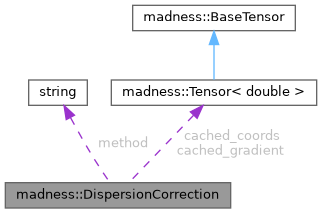
interface class to simple-dftd3, Grimme's D3 empirical dispersion correction More...
#include <dispersion.h>
Public Member Functions | |
| DispersionCorrection ()=default | |
| default ctor – inactive, energy() is 0.0 and gradient() is all zeros | |
| DispersionCorrection (const std::string &spec, const std::string &xc_line, const std::string &functional, const bool atm) | |
construct from the dft input group | |
| bool | active () const |
| true if a correction is actually being applied | |
| std::string | description () const |
| short human-readable tag, e.g. "D3(BJ)/pbe0" – "none" if inactive | |
| double | energy (World &world, const Molecule &mol) const |
| the dispersion energy in Hartree; 0.0 if inactive | |
| Tensor< double > | gradient (World &world, const Molecule &mol) const |
| d E_disp / d R in Hartree/bohr, length 3*natom, laid out [3*atom + axis] | |
| Tensor< double > | hessian (World &world, const Molecule &mol) const |
| d^2 E_disp / dR_i dR_j in Hartree/bohr^2, (3*natom, 3*natom) | |
| void | print_citation (World &world) const |
| print the method and its primary references; a no-op if inactive | |
| void | reject (const char *engine) const |
| same, for an already-constructed correction | |
Static Public Member Functions | |
| static bool | available () |
| true if this build can compute a correction at all | |
| static std::string | library_version () |
| linked simple-dftd3 version as "major.minor.patch", or "" if unavailable | |
| static void | reject (const std::string &spec, const char *engine) |
throw if spec asks for a correction, naming the engine that cannot apply it | |
Private Types | |
| enum | Damping { none , rational , zero } |
Private Member Functions | |
| void | compute (World &world, const Molecule &mol) const |
| evaluate on rank 0 and broadcast; fills the cache below | |
| void | evaluate (const std::vector< int > &numbers, const Tensor< double > &coords, double &e, Tensor< double > &g) const |
Static Private Member Functions | |
| static std::vector< int > | atomic_numbers (const Molecule &mol) |
| the atomic numbers, ordered to match Molecule::get_all_coords() | |
Private Attributes | |
| bool | atm = false |
| include the three-body ATM term | |
| bool | cache_valid = false |
| Tensor< double > | cached_coords |
| double | cached_energy = 0.0 |
| Tensor< double > | cached_gradient |
| bool | citation_printed = false |
| Damping | damping = none |
| std::string | method |
| the method name handed to simple-dftd3's parameter tables | |
Detailed Description
interface class to simple-dftd3, Grimme's D3 empirical dispersion correction
The D3 correction is a closed-form function of the nuclear coordinates alone: it touches neither the density nor the Fock matrix, so it enters a calculation as one additive number in the total energy and one additive tensor in the nuclear gradient.
References
- S. Grimme, J. Antony, S. Ehrlich, H. Krieg, J. Chem. Phys. 132, 154104 (2010), doi:10.1063/1.3382344 [the D3 model]
- S. Grimme, S. Ehrlich, L. Goerigk, J. Comput. Chem. 32, 1456 (2011), doi:10.1002/jcc.21759 [BJ damping]
- implementation: https://github.com/dftd3/simple-dftd3
Requires MADNESS to be configured against simple-dftd3 (-DENABLE_DFTD3=ON, the default, plus a discoverable install); a default constructed object is inactive and returns zeros, but asking for an actual correction in a build without the library throws.
Member Enumeration Documentation
◆ Damping
|
private |
Constructor & Destructor Documentation
◆ DispersionCorrection() [1/2]
|
default |
default ctor – inactive, energy() is 0.0 and gradient() is all zeros
◆ DispersionCorrection() [2/2]
| madness::DispersionCorrection::DispersionCorrection | ( | const std::string & | spec, |
| const std::string & | xc_line, | ||
| const std::string & | functional, | ||
| const bool | atm | ||
| ) |
construct from the dft input group
- Parameters
-
[in] spec "none", "d3bj" or "d3zero" (the dispersionkeyword)[in] xc_line the xcinput line; its first token is the fallback source for the damping parameter set[in] functional explicit functional name (the dispersion_functionalkeyword); empty means derive it fromxc_line[in] atm include the three-body Axilrod-Teller-Muto term
References atm, damping, madness::error(), MADNESS_EXCEPTION, method, none, param, madness::print(), rational, and zero.
Member Function Documentation
◆ active()
|
inline |
true if a correction is actually being applied
Referenced by madness::SCF::solve().
◆ atomic_numbers()
|
staticprivate |
the atomic numbers, ordered to match Molecule::get_all_coords()
the atomic numbers, in the order simple-dftd3 expects the coordinates
References madness::Molecule::get_atomic_number(), and madness::Molecule::natom().
◆ available()
|
static |
true if this build can compute a correction at all
Referenced by main().
◆ compute()
evaluate on rank 0 and broadcast; fills the cache below
References atomic_numbers(), madness::WorldGopInterface::broadcast(), cache_valid, cached_coords, cached_energy, cached_gradient, madness::copy(), e(), evaluate(), madness::g, madness::Molecule::get_all_coords(), madness::World::gop, madness::Molecule::natom(), madness::World::rank(), and madness::BaseTensor::size().
Referenced by energy(), and gradient().
◆ description()
| std::string madness::DispersionCorrection::description | ( | ) | const |
◆ energy()
the dispersion energy in Hartree; 0.0 if inactive
References cached_energy, compute(), damping, and none.
Referenced by madness::SCF::solve().
◆ evaluate()
|
private |
one library call: energy and gradient for a geometry. Rank-local and uncached, so the finite differences in hessian() neither communicate per displacement nor evict the cache.
References atm, damping, e(), madness::error(), madness::g, MADNESS_EXCEPTION, method, param, madness::Tensor< T >::ptr(), rational, and sigma.
◆ gradient()
| Tensor< double > madness::DispersionCorrection::gradient | ( | World & | world, |
| const Molecule & | mol | ||
| ) | const |
d E_disp / d R in Hartree/bohr, length 3*natom, laid out [3*atom + axis]
Same layout as SCF::derivatives and NemoBase::compute_gradient, so the result can be added to those tensors directly. All zeros if inactive.
References cached_gradient, compute(), madness::copy(), damping, madness::Molecule::natom(), and none.
Referenced by madness::SCF::derivatives().
◆ hessian()
| Tensor< double > madness::DispersionCorrection::hessian | ( | World & | world, |
| const Molecule & | mol | ||
| ) | const |
d^2 E_disp / dR_i dR_j in Hartree/bohr^2, (3*natom, 3*natom)
Same [3*atom + axis] index convention as gradient(), so the result can be added straight to Nemo::hessian's matrix. All zeros if inactive.
Central differences of the analytic gradient. simple-dftd3 grew an analytic Hessian (dftd3_get_dispersion_hessian) only in its 1.6 API, which no release carries yet; differencing costs 6*natom library calls of a few microseconds each and lands ~1e-9 Ha/bohr^2 from the exact result, orders of magnitude below the error of the electronic Hessian it joins.
References atomic_numbers(), madness::WorldGopInterface::broadcast(), madness::copy(), damping, e(), evaluate(), madness::Molecule::get_all_coords(), madness::World::gop, h(), madness::Molecule::natom(), none, madness::World::rank(), and x0.
Referenced by test_hessian().
◆ library_version()
|
static |
linked simple-dftd3 version as "major.minor.patch", or "" if unavailable
References v.
Referenced by main(), and print_citation().
◆ print_citation()
| void madness::DispersionCorrection::print_citation | ( | World & | world | ) | const |
print the method and its primary references; a no-op if inactive
Prints at most once per object, so callers on a path that repeats per geometry step (Nemo::value) need no guard of their own.
References citation_printed, damping, description(), library_version(), none, madness::print(), madness::World::rank(), and rational.
Referenced by main().
◆ reject() [1/2]
|
inline |
same, for an already-constructed correction
References description(), and reject().
Referenced by reject().
◆ reject() [2/2]
|
static |
throw if spec asks for a correction, naming the engine that cannot apply it
For engines whose energy expression has no dispersion term. Silently dropping the correction would report an uncorrected energy as the answer to a deck that asked for a corrected one. A no-op for "none"/"", so call sites need no guard of their own.
Takes the raw dispersion keyword because not every such engine owns an SCF to ask – Znemo carries a bare CalculationParameters.
References MADNESS_EXCEPTION, and madness::print().
Referenced by test_bad_input(), and madness::Znemo::value().
Member Data Documentation
◆ atm
|
private |
include the three-body ATM term
Referenced by DispersionCorrection(), description(), and evaluate().
◆ cache_valid
|
mutableprivate |
Referenced by compute().
◆ cached_coords
|
mutableprivate |
memoized result – SCF::solve asks once per iteration for a quantity that only changes when the optimizer moves the nuclei
Referenced by compute().
◆ cached_energy
|
mutableprivate |
◆ cached_gradient
|
mutableprivate |
Referenced by compute(), and gradient().
◆ citation_printed
|
mutableprivate |
Referenced by print_citation().
◆ damping
Referenced by DispersionCorrection(), active(), description(), energy(), evaluate(), gradient(), hessian(), and print_citation().
◆ method
|
private |
the method name handed to simple-dftd3's parameter tables
Referenced by DispersionCorrection(), description(), and evaluate().
The documentation for this class was generated from the following files: