the cuspy half of the nemo tau decomposition, supplied pointwise More...
#include <xcfunctional.h>
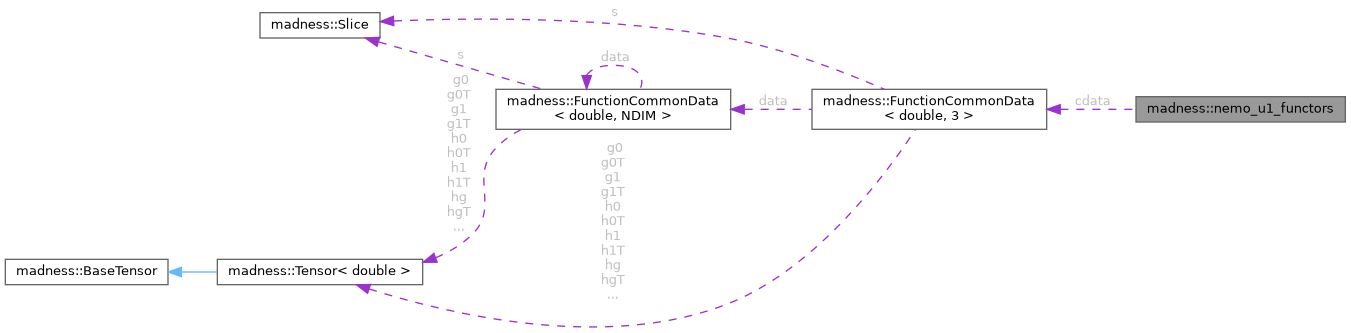
Public Types | |
| typedef madness::FunctionFunctorInterface< double, 3 > | functorT |
Public Member Functions | |
| nemo_u1_functors () | |
| nemo_u1_functors (const std::vector< std::shared_ptr< functorT > > &u1) | |
| bool | active () const |
| void | append (const madness::Key< 3 > &key, std::vector< madness::Tensor< double > > &t) const |
| write U1 and |U1|^2 at this box's quadrature points into t[enum_u1*] | |
Public Attributes | |
| madness::FunctionCommonData< double, 3 > | cdata |
| std::vector< std::shared_ptr< functorT > > | f |
Detailed Description
the cuspy half of the nemo tau decomposition, supplied pointwise
Holds the four analytic ncf quantities that must never become MRA functions – 
The point is that nothing is projected. A product of U1 with anything, formed as a Function, has to be represented on some tree; on a tree too coarse for U1's eprec-scale structure the polynomial fit rings across the whole box. Evaluating U1 here instead means its values go straight into the functional's pointwise arithmetic and only the potential is ever projected – which the existing machinery already does, and already has to.


Member Typedef Documentation
◆ functorT
| typedef madness::FunctionFunctorInterface<double,3> madness::nemo_u1_functors::functorT |
Constructor & Destructor Documentation
◆ nemo_u1_functors() [1/2]
|
inline |
◆ nemo_u1_functors() [2/2]
|
inlineexplicit |
- Parameters
-
[in] u1 x, y, z components of U1 followed by |U1|^2 – four functors
References f, and MADNESS_CHECK_THROW.
Member Function Documentation
◆ active()
|
inline |
References f.
Referenced by append(), madness::xc_functional::operator()(), and madness::xc_potential::operator()().
◆ append()
|
inline |
write U1 and |U1|^2 at this box's quadrature points into t[enum_u1*]
References active(), c, cdata, madness::BaseTensor::dim(), madness::XCfunctional::enum_rhoa, madness::XCfunctional::enum_u1_x, madness::XCfunctional::enum_u1_y, madness::XCfunctional::enum_u1_z, madness::XCfunctional::enum_u1sq, f, madness::FunctionDefaults< NDIM >::get_cell(), madness::FunctionDefaults< NDIM >::get_cell_width(), h(), k, madness::Key< NDIM >::level(), MADNESS_CHECK_THROW, madness::XCfunctional::number_xc_args, p(), q(), madness::FunctionCommonData< T, NDIM >::quad_x, madness::Key< NDIM >::translation(), and v.
Referenced by madness::xc_functional::operator()(), and madness::xc_potential::operator()().
Member Data Documentation
◆ cdata
| madness::FunctionCommonData<double,3> madness::nemo_u1_functors::cdata |
Referenced by append().
◆ f
| std::vector<std::shared_ptr<functorT> > madness::nemo_u1_functors::f |
Referenced by nemo_u1_functors(), active(), and append().
The documentation for this struct was generated from the following file: