Foo Class Reference
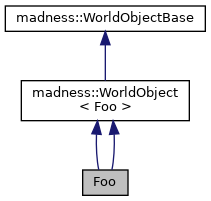
Inheritance diagram for Foo:
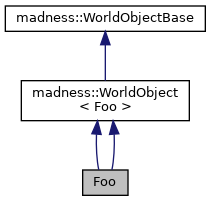
Collaboration diagram for Foo:
Public Member Functions | |
| Foo (World &world, int a) | |
| Foo (World &world, int bar) | |
| virtual | ~Foo () |
| virtual | ~Foo () |
| const std::vector< double > & | dbuf () const |
| const std::vector< double > & | dbuf_long () const |
| const std::vector< double > & | dbuf_short () const |
| decltype(auto) | get () const |
| int | get0 () |
| int | get0c () const |
| Future< int > | get0f () |
| int | get1 (int a1) |
| int | get1c (int a1) const |
| int | get2 (int a1, char a2) |
| int | get2c (int a1, char a2) const |
| int | get3 (int a1, char a2, short a3) |
| int | get3c (int a1, char a2, short a3) const |
| int | get4 (int a1, char a2, short a3, long a4) |
| int | get4c (int a1, char a2, short a3, long a4) const |
| int | get5 (int a1, char a2, short a3, long a4, short a5) |
| int | get5c (int a1, char a2, short a3, long a4, short a5) const |
| double | getbuf0 (const std::vector< double > &buf) |
| double | getbuf0c (const std::vector< double > &buf) const |
| void | ping (int from, int speed) |
| void | ping_am (int from, int speed) |
| void | pong (int from, int speed) |
| void | pong_am (int from, int speed) |
| Public Member Functions inherited from madness::WorldObject< Foo > | |
| WorldObject (const WorldObject &other) | |
| virtual | ~WorldObject () |
| WorldObject & | operator= (const WorldObject &)=delete |
| detail::task_result_type< memfnT >::futureT | send (ProcessID dest, memfnT memfn) const |
| detail::task_result_type< memfnT >::futureT | task (ProcessID dest, memfnT memfn, const TaskAttributes &attr=TaskAttributes()) const |
| Sends task to derived class method returnT (this->*memfn)(). | |
| Public Member Functions inherited from madness::WorldObjectBase | |
| virtual | ~WorldObjectBase () |
| World & | get_world () const |
| World & | get_world_noexcept () const noexcept |
| Get the world to which this object belongs, without risking a throw. | |
| const uniqueidT & | id () const |
| Returns the globally unique object ID. | |
| bool | world_is_alive () const noexcept |
| Reports whether the world to which this object belongs still exists. | |
Private Attributes | |
| int | a |
| std::vector< int > | bar |
| std::vector< double > | dbuf_long_ |
| std::vector< double > | dbuf_short_ |
Additional Inherited Members | |
| Public Types inherited from madness::WorldObject< Foo > | |
| typedef WorldObject< Foo > | objT |
| Protected Member Functions inherited from madness::WorldObject< Foo > | |
| void | process_pending () |
| To be called from derived constructor to process pending messages. | |
| Protected Member Functions inherited from madness::WorldObjectBase | |
| WorldObjectBase (const WorldObjectBase &other) | |
| Copy constructor; produces an unregistered object. | |
| WorldObjectBase (World &w) | |
| Construct a new WorldObjectBase. | |
| World & | get_world_unchecked () const noexcept |
| Unchecked access to the memoized world reference. | |
| template<typename DerivedT> | |
| void | register_self (DerivedT *this_ptr) |
| Registers this object with its world, making it globally addressable. | |
Constructor & Destructor Documentation
◆ Foo() [1/2]
|
inline |
◆ ~Foo() [1/2]
|
inlinevirtual |
◆ Foo() [2/2]
|
inline |
◆ ~Foo() [2/2]
|
inlinevirtual |
Member Function Documentation
◆ dbuf()
|
inline |
References dbuf_long().
◆ dbuf_long()
|
inline |
References dbuf_long_.
Referenced by dbuf().
◆ dbuf_short()
|
inline |
References dbuf_short_.
◆ get()
◆ get0()
◆ get0c()
◆ get0f()
◆ get1()
◆ get1c()
◆ get2()
◆ get2c()
◆ get3()
◆ get3c()
|
inline |
◆ get4()
|
inline |
◆ get4c()
|
inline |
◆ get5()
|
inline |
◆ get5c()
|
inline |
◆ getbuf0()
|
inline |
◆ getbuf0c()
|
inline |
◆ ping()
|
inline |
◆ ping_am()
|
inline |
◆ pong()
|
inline |
References madness::WorldObjectBase::get_world(), ping(), madness::print(), and madness::WorldObject< Foo >::task().
Referenced by ping().
◆ pong_am()
|
inline |
References madness::WorldObjectBase::get_world(), ping_am(), madness::print(), and madness::WorldObject< Foo >::send().
Referenced by ping_am().
Member Data Documentation
◆ a
|
private |
◆ bar
◆ dbuf_long_
|
private |
Referenced by Foo(), and dbuf_long().
◆ dbuf_short_
|
private |
Referenced by Foo(), and dbuf_short().
The documentation for this class was generated from the following files:
Generated on for MADNESS by
 1.15.0