Distributed caching utility. More...
#include <dist_cache.h>
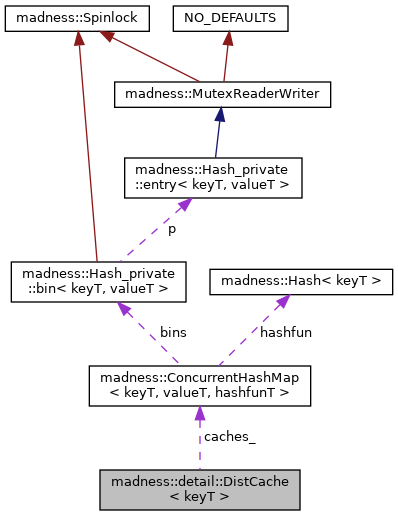
Classes | |
| class | Cache |
| Cache interface class. More... | |
| class | CacheData |
| Cache value container. More... | |
Static Public Member Functions | |
| template<typename valueT> | |
| static madness::Future< valueT > | get_cache_value (const keyT &key) |
Get the cache value accosted with key. | |
| template<typename valueT> | |
| static void | get_cache_value (const keyT &key, madness::Future< valueT > &value) |
Get the cache value accosted with key. | |
| template<typename valueT> | |
| static void | set_cache_value (const keyT &key, const valueT &value) |
Set the cache value accosted with key. | |
Private Types | |
| typedef madness::ConcurrentHashMap< keyT, Cache * > | cache_container |
| The container that holds cache values. | |
| typedef cache_container::datumT | datum_type |
| Cache container datum type. | |
Static Private Attributes | |
| static cache_container | caches_ |
| Cache container. | |
Detailed Description
class madness::detail::DistCache< keyT >
Distributed caching utility.
This object implements a local, key-value caching mechanism that can be used by remote tasks or active messages to move data between processes without synchronization. Because cache values are retrieved via a Future, you can get or set the cache in any order. The first call get_cache_value or set_cache_value or will insert the cache element, and the second call to these functions will remove it. Therefore, set_cache_value and get_cache_value can only be called once each per cache value.
- Template Parameters
-
keyT The key type of the cache
Member Typedef Documentation
◆ cache_container
|
private |
The container that holds cache values.
◆ datum_type
|
private |
Cache container datum type.
Member Function Documentation
◆ get_cache_value() [1/2]
|
inlinestatic |
Get the cache value accosted with key.
This will get the value associated with key to value. If the cache element does not exist, it is inserted into the cache. Otherwise, it is removed from the cache.
- Template Parameters
-
valueT The object type that will be used to set the cache
- Parameters
-
[in] key The key associated with value
- Returns
- A
Futurethat holds/will hold the cache value, which will be set by a call toset_cache_value.
References madness::cache, caches_, madness::Future< void >::value, and madness::Hash_private::HashAccessor< hashT, lockmode >::release().
◆ get_cache_value() [2/2]
|
inlinestatic |
Get the cache value accosted with key.
This will get the value associated with key to value. The value is given in the form of a Future, which is set by a call to set_cache_value. If the cache element does not exist, it is inserted into the cache. Otherwise, it is removed from the cache.
- Template Parameters
-
valueT The object type that will be used to set the cache
- Parameters
-
[in] key The key associated with value[out] value The data that will be cached
References madness::cache, caches_, madness::Future< void >::value, and madness::Hash_private::HashAccessor< hashT, lockmode >::release().
Referenced by madness::WorldGopInterface::bcast_internal(), and madness::WorldGopInterface::bcast_internal().
◆ set_cache_value()
|
inlinestatic |
Set the cache value accosted with key.
This will set the value associated with key to value. If the cache element does not exist, it is inserted into the cache. Otherwise, it is removed from the cache.
- Template Parameters
-
valueT The object type that will be used to set the cache (may be a madness::Futuretype).
- Parameters
-
key The key associated with valuevalue The data that will be cached
References madness::cache, caches_, madness::f, madness::Future< void >::value, MADNESS_ASSERT, and madness::Hash_private::HashAccessor< hashT, lockmode >::release().
Referenced by madness::WorldGopInterface::bcast_task(), and madness::WorldGopInterface::group_bcast_task().
Member Data Documentation
◆ caches_
|
staticprivate |
Cache container.
Referenced by get_cache_value(), get_cache_value(), and set_cache_value().
The documentation for this class was generated from the following file:
Generated on for MADNESS by
 1.15.0