#include <worldmutex.h>
Public Member Functions | |
| Barrier (int nthread) | |
| bool | enter (const int id) |
| Each thread calls this with its id (0,..,nthread-1) to enter the barrier. | |
| void | register_thread (int id, std::atomic< bool > *pflag) |
| Each thread calls this once before first use. | |
Private Attributes | |
| const int | nthread |
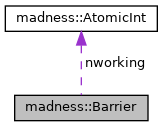
| AtomicInt | nworking |
| std::atomic< bool > * | pflags [MAX_NTHREAD] |
| std::atomic< bool > | sense |
Static Private Attributes | |
| static const int | MAX_NTHREAD = 128 |
Constructor & Destructor Documentation
◆ Barrier()
Member Function Documentation
◆ enter()
|
inline |
Each thread calls this with its id (0,..,nthread-1) to enter the barrier.
The thread last to enter the barrier returns true. Others return false.
All calls to the barrier must use the same value of nthread.
References madness::cpu_relax(), madness::AtomicInt::dec_and_test(), MADNESS_EXCEPTION, MADNESS_MEMORY_LOAD_BARRIER, MADNESS_MEMORY_STORE_BARRIER, MAX_NTHREAD, nthread, nworking, pflags, and sense.
Referenced by madness::TaskThreadEnv::barrier().
◆ register_thread()
|
inline |
Each thread calls this once before first use.
id should be the thread id (0,..,nthread-1) and pflag a pointer to a thread-local atomic flag (probably in the thread's stack)
References MADNESS_EXCEPTION, MAX_NTHREAD, pflags, and sense.
Member Data Documentation
◆ MAX_NTHREAD
|
staticprivate |
Referenced by enter(), and register_thread().
◆ nthread
◆ nworking
◆ pflags
|
private |
Referenced by enter(), and register_thread().
◆ sense
|
private |
Referenced by enter(), and register_thread().
The documentation for this class was generated from the following file: