an N-dimensional real-valued Gaussian function More...
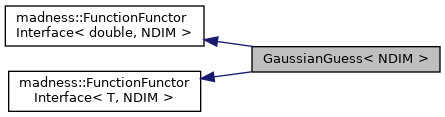
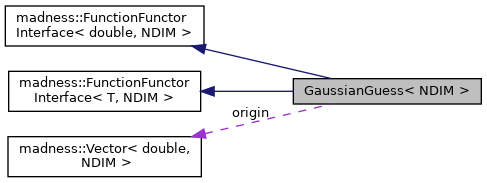
Public Member Functions | |
| GaussianGuess (const coordT &origin, const double alpha, const std::vector< int > ijk=std::vector< int >(NDIM)) | |
| ctor | |
| GaussianGuess (const coordT &origin, const double alpha, int l) | |
| ctor | |
| T | operator() (const coordT &xyz) const |
| virtual function cannot be SFINAE'ed | |
| template<class R = T> | |
| std::enable_if< std::is_same< R, std::complex< double > >::value, R >::type | val (const coordT &xyz) const |
| template<class R = T> | |
| std::enable_if< std::is_same< R, double >::value, R >::type | val (const coordT &xyz) const |
 Public Member Functions inherited from madness::FunctionFunctorInterface< T, NDIM > Public Member Functions inherited from madness::FunctionFunctorInterface< T, NDIM > | |
| FunctionFunctorInterface () | |
| virtual | ~FunctionFunctorInterface () |
| virtual coeffT | coeff (const keyT &) const |
| virtual void | operator() (const Vector< double *, 1 > &, T *, int) const |
| virtual void | operator() (const Vector< double *, 2 > &, T *, int) const |
| virtual void | operator() (const Vector< double *, 3 > &, T *, int) const |
| virtual void | operator() (const Vector< double *, 4 > &, T *, int) const |
| virtual void | operator() (const Vector< double *, 5 > &, T *, int) const |
| virtual void | operator() (const Vector< double *, 6 > &, T *, int) const |
| virtual bool | provides_coeff () const |
| does this functor directly provide sum coefficients? or only function values? | |
| virtual bool | screened (const Vector< double, NDIM > &, const Vector< double, NDIM > &) const |
| Can we screen this function based on the bounding box information? | |
| void | set_length_scale (double lo) |
| adapt the special level to resolve the smallest length scale | |
| virtual Level | special_level () const |
| Override this to change the minimum level of refinement at special points (default is 6) | |
| virtual std::vector< Vector< double, NDIM > > | special_points () const |
| Override this to return list of special points to be refined more deeply. | |
| virtual bool | supports_vectorized () const |
| Does the interface support a vectorized operator()? | |
| virtual coeffT | values (const keyT &, const Tensor< double > &) const |
Public Attributes | |
| double | exponent |
| exponent of the guess | |
| std::vector< int > | ijk |
| cartesian exponents | |
| int | l =0 |
| magnetic quantum number (if T=double_complex) | |
| coordT | origin |
| double | phase =double(rand()%1000)/1000.0 |
| complex phase (if applicable) | |
| Public Attributes inherited from madness::FunctionFunctorInterface< T, NDIM > | |
| Level | special_level_ |
Private Types | |
| typedef Vector< double, NDIM > | coordT |
Additional Inherited Members | |
| Public Types inherited from madness::FunctionFunctorInterface< T, NDIM > | |
| typedef GenTensor< T > | coeffT |
| typedef Key< NDIM > | keyT |
| typedef T | value_type |
Detailed Description
class GaussianGuess< T, NDIM >
an N-dimensional real-valued Gaussian function
the function looks like [ f(r) = x^i y^j .. z^k exp(-alpha r^2) ]
Member Typedef Documentation
◆ coordT
|
private |
Constructor & Destructor Documentation
◆ GaussianGuess() [1/2]
|
inline |
ctor
- Parameters
-
[in] origin the origin of the Gauss function [in] alpha the exponent exp(-alpha r^2) [in] ijk the monomial x^i y^j z^k exp(-alpha r^2) (for NDIM)
References GaussianGuess< T, NDIM >::ijk, and GaussianGuess< T, NDIM >::l.
◆ GaussianGuess() [2/2]
|
inline |
ctor
- Parameters
-
[in] origin the origin of the Gauss function [in] alpha the exponent exp(-alpha r^2) [in] ijk the monomial x^i y^j z^k exp(-alpha r^2) (for NDIM)
References std::abs(), GaussianGuess< T, NDIM >::ijk, GaussianGuess< T, NDIM >::l, NDIM, and madness::nonlinear_vector_solver().
Member Function Documentation
◆ operator()()
|
inlinevirtual |
virtual function cannot be SFINAE'ed
Implements madness::FunctionFunctorInterface< T, NDIM >.
References madness::nonlinear_vector_solver(), and GaussianGuess< T, NDIM >::val().
◆ val() [1/2]
◆ val() [2/2]
Member Data Documentation
◆ exponent
| double GaussianGuess< T, NDIM >::exponent |
exponent of the guess
Referenced by GaussianGuess< T, NDIM >::val().
◆ ijk
| std::vector<int> GaussianGuess< T, NDIM >::ijk |
cartesian exponents
Referenced by GaussianGuess< T, NDIM >::GaussianGuess(), GaussianGuess< T, NDIM >::GaussianGuess(), and GaussianGuess< T, NDIM >::val().
◆ l
| int GaussianGuess< T, NDIM >::l =0 |
magnetic quantum number (if T=double_complex)
Referenced by GaussianGuess< T, NDIM >::GaussianGuess(), and GaussianGuess< T, NDIM >::GaussianGuess().
◆ origin
| coordT GaussianGuess< T, NDIM >::origin |
Referenced by GaussianGuess< T, NDIM >::val().
◆ phase
| double GaussianGuess< T, NDIM >::phase =double(rand()%1000)/1000.0 |
complex phase (if applicable)
Referenced by GaussianGuess< T, NDIM >::val().
The documentation for this class was generated from the following file: